Monday, June 25, 2012

dwell design at the Los Angeles Convention Center


Last week, I was in the domain of a modernist design icon - the Eames
house in Pacific Palisades. This week, I entered the world of a highly 
successful commercial enterprise which purports to represent modernist 
design. Based on my blog, I was able to obtain a media pass to the
dwell show at the Los Angeles Convention Center. (see above)

Having avoided shopping malls most of my adult life, I am a total novice
in the world of present day consumerism. When my wife Mary had a
specialty food business, I would help her set up at the food shows in New
York's Javits Convention Center. There, we were exposed to the underbelly
of the convention center world and learned how to cope with the mafia
controlled workforce there. In Milan, I had attended several big trade
furniture shows and was prepared for the worst - bad design promoted as
good design, with emphasis on commerce at a banal level.

Much to my surprise, I found "dwell on design" to be a reasonable
mix of some interesting designs, some blatantly commercial products
and some innovative designs offering real promise. "dwell magazine"

is a coherent and  tasteful presentation of living with modern. Much as
"Design Within Reach" has created a network of stores where many
 classic examples of modern furniture can be purchased along with work
by younger designers, "dwell magazine" has expanded knowledge of
modern design to broader audiences representing a younger generation.
My taste is more orthodox, so I am never going to be a big fan of popularized
consumer modern.


Perhaps most significant for me was the discovery of a
brilliant innovative design by students from Woodbury
    University School of Architecture. It is a universal joint
    system that offers incredible flexibility. It is not a replica
    of Buckminster Fuller's geodesic dome system; it goes
    beyond that by making it possible to create shapes of
    infinite variety.


    From left to right: Jesse Cabildo, Andre Gharakhanian, and
    Charles Ghiotto. Knowing of his interest in innovative design,
    I contacted Rolf Fehlbaum, head of VITRA furniture in Basel,
    Switzerland, hoping that he might have an interest in this
    innovative concept.


    As the owner of five "Artimede" lamps and four "Luceplan" lamps,
    I am partial to modern Italian lamps.  The "Koncept" LED lamps,
    made in Hong Kong, were a discovery. Selling in the range of
    $250, they are a great design at a great price.


    As a footnote, eleven year-old Kenneth Parel-Sewell's prize
    winning Lego house design was sheer delight, as was he.

Thursday, June 21, 2012

Revisiting the Eames House after 60 years


On Saturday,  June 16, I was privileged to be invited to view the Eames
House at 203 Chautauqua Boulevard in Pacific Palisades, to celebrate
the nearly completed restoration of the house, and to celebrate Ray Eames'
100th birthday. I had been there often between 1951 and 1955. It was
nearly sixty years ago when I last saw the house.  Sixty years ago, it was
my good fortune to have been a periodic guest in the house, to engage in
illuminating discussions with Charles and to enjoy Ray's culinary treats
presented as beautifully organized visual displays.

The Eames House was one of John Entenza's landmark Case Study Houses -
http://en.wikipedia.org/wiki/Arts_%26_Architecture
a series of modernist homes designed by architects who were engaged in
the  process of transforming American domestic architecture. Los Angeles,
at this time,  was a caldron in which masters and experimenters, among them,
Frank Lloyd Wright, Richard Neutra, Rudolph Schindler, Raphael Soriano
and John Lautner were most visible.

Although Charles was trained as an architect, the house at 203 Chautauqua
Boulevard could not be described as a product of traditional architectural
practice. It was designed to utilize standard, industrially mass-produced
"off-the-shelf" components. These standard elements were orchestrated to
create a non-standard solution. It was a home, a studio, a space in which to
entertain guests and a display area for their latest creations. It served the
dynamic nature of their personal and professional lives.

Viewing it again after a nearly sixty-year hiatus,  I found that the design is
still as fresh (to my eyes), as it was when I first saw it. It falls into the category
of iconic designs, those that possess sufficiently innovative characteristics
to withstand the ravages of time.

About fifteen years ago, through my friend, Jean Dethier, then head of the
Centre de création industrielle at the Centre Pompidou in Paris, I was able to
visit the recently refurbished Villa Savoye, one of the most significant icons
of moderist residential architecture designed by Le Corbusier in 1929 and
completed in 1931.


When I visited the Villa Savoye, the interior was barren, as were the spaces
at the Eames house, so that it was possible to appreciate the inherent clarity
of design in both places. There is no direct connection between these two
structures; however, there is a symbiotic/stylistic association. Both possess
refined organization of space and polished detailing. Both were situated to
harmonize with their settings in nature and to embrace that connection with
what we might call "indoor/outdoor" spaces. My predilection has always
been toward "modernist" design of which these two buildings are outstanding
examples.

We are fortunate that both buildings are being preserved for posterity. The
Villa Savoye fell into disrepair and was being threatened with demolition.
It was designated as an official French historical monument in 1965 (a rare 
occurrence, as Le Corbusier was still living at the time). It was thoroughly 
renovated from 1985 to 1997. Today, it is under the care of the Centres des
monuments nationaux and the refurbished house is open to visitors year-round.

The Eames House is owned and maintained by the Charles and Ray Eames
House Preservation Foundation and administered by family members.
http://eamesfoundation.org/eames-foundation-mission
According to Lucia, Charles' daughter, " We have to make the work of
Charles and Ray relevant to the future. The house will always give a feel
for their approach."


As I continue to struggle attempting to find both a niche and an identity
for myself in Los Angeles, making this connection with Charles and Ray
provided me with the opportunity to draw on pages from my past and to
associate them with my present.

I often describe Charles as my mentor. I wanted to reside within the domain
of his perfectionist standards. I recall sitting in the living room alcove as he
lamented errors that he had made in the design of the sofa compact. He said,
"As soon as I have finished designing something, I can see all of the mistakes
that I made." With regard to the sofa compact, we had one in our home for
many years and I never found any detail that was not perfect.

My unforgettable experiences with Ray revolve around food. To have her
serve breakfast, was a gustatory and visual delight. Her soft boiled eggs
were always perfect as were the breads, pastries and jams which she served.
Flowers and Mexican candelabra, perfectly orchestrated in size, shape and
color complemented the tastes and textures of the food.

If Charles and Ray found living in LA to be a hospitable, exciting and
rewarding experience, perhaps I can,  yet, learn another lesson from them.

FOOTNOTE

Kevin Roderick of LA Observed wrote and I responded:

______________________________________________________________
On Jun 22, 2012, at 8:56 AM, Kevin Roderick wrote:

Thanks, Allon. interesting. 

I guess you don't want to say what you were doing there in the 50s?

Best,
Kevin

____________________________________________________________

Dear Kevin,
From 1950-1955, I was a curator at the then San Francisco Museum of Art (now SFMOCA). I created a series of tv shows presenting the museum and local artists to a new and different audience - 300,000 people - four times the museum's annual attendance. There was no cultural programming on tv in the early 1950s. 

Betty Chamberlain, art critic for Time, brought Charles and Ray to meet me and see one of my shows in production. Thus began one of the most important relationships in my life.While I was in San Francisco, I saw a lot of them, here and there. They invited me to stay at the house when I came to LA. 

People search for mentors; mine came to me. About a year after our first contact, we collaborated on one of my tv shows. Charles made a film on the development of the plywood chair for that show. Eames Demetrious found a kinescope (a film of the tv monitor - the only recording device available at that time). Bobbye Tigerman included it in the design show at LACMA and I have a credit - my first museum credit in LA! 

Hope that answers your question
Cordially,
Allon


Thursday, February 23, 2012

Why I Voted for "The Artist" as Best Picture

I have seen it three times:
January 16, 2012, 4:00pm
Landmark Theater
10580 West Pico Blvd. 
Los Angeles, 90064
January 30, 2012, 7:30pm
TV Academy
 5230 Lankershim Blvd.
North Hollywood, 91601
A screening followed by a question and answer with writer/director Michel
Hazanavicius, star Jean Dujardin, actor James Cromwell, costume designer
Mark Bridges, and production designer Laurence Bennett. 
February 7, 2012, 7:30pm
Directors Guild Theater, #1
7920 W. Sunset Blvd.
Los Angeles, 90046
A screening followed by a question and answer with executive producer Richard
Middleton, executive producer Antoine De Cazotte, director of photography
Guillaume Schiffman, costume designer Mark Bridges and production designer
Laurence Bennett. 

"A Masterpiece" 

At the Directors Guild Theater, as I scrambled to permit a dowdy sixty year-old 
woman sitting next to me make her way to the bathroom, she murmured, "As a
member of the Academy, I see two hundred pictures a year." She returned and
we sat in silence throughout viewing "The Artist." When it ended, spontaneously
she exclaimed "A masterpiece." I buy that!

Is "The Artist" a French film or a Hollywood film?  
Because it was made in Hollywood, it qualifies as an American made film
and can be considered for Oscars; however, it clearly demonstrates French
style and sensibility. Film credits abound with American names, but no American
director could have conceived of making a silent film today. When asked why
he chose to make a silent film, writer/director Michel Hazanavicius said that
it was the logical way deal with the film's themes: the end of the silent film
era, the birth of sound movies and the consequences that ensued. Asked if
he would make another silent film, Michel Hazanavicius' reply was emphatically
negative. "The Artist" is not a tour de force nor a gimmick. Hazanavicius sought
to evoke nostalgia during a moment of crucial transition in the history of motion
pictures. Thus, a silent film in aHollywood setting.

Rather than a blunt exposition, he chose to create a credible fantasy in which
we are witness to the vicissitudes of stardom, an often told tale.  Hazanavicius
is a product of the French school of "auteur" filmmaking in which a director
is granted license (generally within the bounds of commercial viability) to
express oneself.

So what do I know about Hollywood films?  
In the 50s and 60s, I managed to have contact with some of the great directors
of that period: Vincent Minnelli, Rouben Mamoullian, George Stevens and Fred
Zinnemann.

Vincent Minnelli got Best Picture for "An American in Paris," in 1951
http://www.youtube.com/watch?v=FiiaJRXPAm4
and " Gigi" in 1958.
http://www.youtube.com/watch?v=jEofRODHZ1w

George Stevens got Best Director for "A Place in Sun," in 1952
http://www.youtube.com/watch?v=wEuFNnJSIw8
and Best Director for "Giant" in 1956.
http://www.youtube.com/watch?v=w2x6AT4mr3o

Fred Zinnemann got Best Director
for "From Here to Eternity" in 1953
http://www.youtube.com/watch?v=_reftTX0Ayg

These films were grand epics, solidly produced and refined in detail. The casts
provided outstanding performances. These films continue to resonate for me as
demonstrations of some of the best that Hollywood has to offer. There is no
question that episodic changes in style occur in every creative medium. Perhaps
my taste in films is stuck in the 50s and 60s, or perhaps films of this era
demonstrate a cohesion seldom found today?

Filmmaking aside, I had a modest impact in Hollywood at this time. Returning
from a trip to Italy with a home espresso maker, I told Rouben Mamoulian's wife
about it. She wanted one. I sent one to her and can make the dubious claim that I
introduced the first home espresso maker to Hollywood.

What do I know about French films? 
I am a fan of Godard and am familiar with the films of the other directors of
Nouvelle Vague fame. Over the last forty years, I have probably seen twice as
many French and Italian films than American films. Rather than knowledge
of films, my expertise regarding France stems more from everyday experience.
While in graduate school, I would hang out in Paris, sitting in Deux Magots
on the Boulevard St. Germain with a Galoise dangling from my lip, waiting
for Sartre or Simone de Beauvoir to appear. Over the years, I got to know Paris
well enough to lead a group of New York architects, planners and city officials
around examining Paris as an evolving global city. I even wrote an article in
French that appeared in Libération.

What do I know about French sensibility as it applied to "The Artist?" 
This has to be a personal and subjective judgement, but I am willing to take a
shot at it. I see "The Artist," not in universal terms, but as a manifestation of
French style in its ability to elevate the mundane to more "heroic" terms.
Perhaps this might explain the enduring universal appeal of Antoine de St.
Exupéry's novella The Little Prince. For me, "The Artist" resonates a similar
appeal; however, its appeal is not in fantasy. Rather than fantasy, its appeal
can be seen as a parable (success is ephemeral) for everyone.


Art Versus Commerce / Commerce Versus Art 
When the Weinstein Company enters the picture, the fine line between art
and commerce frays; however, that is not to say that is necessarily bad.
The flood of newspaper ads, the multiple screenings, the tv appearances,
and YouTube trailer all contribute to selling "the product."

My Oscar predictions
It is an irresistible masterpiece. It is going to get Best Picture and Best
Director (Michel Hazanavicius), Best Leading Actor (Jean Dujardin),
and possibly more.

Footnote
I am not a member of The Academy nor any of the guilds. However, I fit
the LA Times' recently published demographic for Academy members. I
am Caucasian and over sixty.


Saturday, December 3, 2011

My Take on How Los Angeles Invented the World


On November 19,  2011, a program entitled "How Los Angeles Invented the World," was presented at The Getty Center as an event associated with Pacific Standard Time: Art in LA. 1945-1980.
http://www.pacificstandardtime.org/
A shuffled replay of this event can be s
een: 
http://zocalopublicsquare.org/thepublicsquare/2011/11/20/was-ever-a-city-more-bewildering/read/the-takeaway/

 In a previous blog post, I criticized the organizers of "How Los Angeles Invented the World" for presenting a program without significant content that veered toward boosterism.


So, here's my take. There is no question that Los Angeles has and continues to make contributions to our global society in two principle areas: the entertainment industry and the space program.  Being more familiar with cultural history, I will begin with the entertainment industry.

LA Invented the Academy Awards


In 2010, approximately 41,300,000 people watched the Academy Awards in the 
United States.  One night, once a year, lasting 3.5 hours, the eyes and ears of  the
world  are focused on Los Angeles. There is no other place on earth commanding
that kind of attention on an annual basis.  It is in the arena of mass communication
culture that LA has invented a new world. So, what are the Oscar attractions? It 
offers mesmerizing presentations of fashion, glamour, fame and celebrity. Did LA 
invent fashion,  glamour, fame and celebrity? No, they have been around for a long
time; however, LA has turned them into global mass market commodities.

Suggested panelist: Dawn Hudson, CEO, The Academy of Motion Picture of Arts and Sciences.

Fashion, glamour, fame and celebrity in Ancient Rome 
Ancient Rome was awash with all of these personal attributes. The most famous person of this era and its most enduring celebrity was Cleopatra, a Hellenistic Egyptian woman of noble heritage whose life was entwined with, among others, two Roman leaders: Julius Caesar and Marc Antony. In their Preface to the 2001 catalogue of The British Museum exhibition, "Cleopatra of Egypt," Susan Walker and Peter Higgs ask, "Who's my Cleopatra?',  for it is abundantly clear that there are many Cleopatras (an ambivalence encouraged in her lifetime by the queen) ..." For the less historically minded and more Hollywood influenced, the answer to "Who's my Cleopatra?" would be Elizabeth Taylor.

Top image: Cleopatra, bronze 80 drachma coin, Alexandria, 51-30 BCE.  Below: Elizabeth Taylor as Cleopatra, 1963.


Suggested panelist: a curator from the Getty Villa.

The Movies Come to Hollywood


Cecil B. DeMille on the running board with some of the actors in his movie, The Squaw Man, 1914.  DeMille left New York with cast and crew prepared to make the film in Flagstaff, Arizona.  When they arrived, they found the scenery unsuitable, so they headed for Hollywood, thus accelerating the development of the motion picture industry.


In the 19th century, traditional culture, theatre and symphony performances, found
an audience in the educated upper class and arriviste bourgeoisie. With the emergence
of an industrial consumer society in the late 19th century, the birth of  the urban
working class heralded a new social phenomenon; there were no precedents providing
entertainments for this expanding population. Vaudeville and its companion, burlesque,
first seen in store front theatres, emerged as low-priced forms of entertainment accesible
to all classes. Vaudeville theatres catered to the broad masses as well as to audiences of
traditional theatres and concert halls. Penny arcades and nickelodeons, where primitive
motion pictures were shown, catered to similar audiences. All four, served as incubators
for the motion picture industry which initiated the era of industrialized entertainments.
As a footnote, throughout the 1930s, films, as attractions, did not stand on their own;
vaudeville acts served as an introduction to film showings.

Suggested panelist: David Nasaw,  Arthur M. Schlesinger, Jr. Professor of History,
The Graduate Center, City University of New York, author of  Going Out: The Rise and
Fall of Public Entertainments.


The Creation of Celebrity Culture


                                  Clark Gable and Vivien Leigh, Gone With The Wind, 1939. 


Celebrity, as we know it today, is a product of our consumer oriented industrial society. Each new technology has made its contribution: telegraph, telephone, motion pictures, recorded sound, radio, television and the internet. As new forms of entertainment have evolved, they have spawned an army of supporting promotional entities: agents, publicists, columnists and fan publications serving intoxicated public appetite for identification with fame.


                                    The Walk of Fame, Hollywood Boulevard, Los Angeles, 2011. 


 A Hollywood product, Desi Arnaz and Lucille Ball in their highly successful sitcom television series,  "I Love Lucy," 1955. At the time, it was one of the most watched tv shows in America. Reruns are still seen by 40 million Americans each year.


 Michael Jackson personified, the ultimate "pop music star."  This album was issued in 2008 on the  occasion of this 50th birthday. It was released in 26 countries.


American Idol: The Search for a Superstar, is currently the most-watched show on American television. It began in 2002.  As an adaptation of a British tv program, it did not originate in Los Angeles; however, it was identified with Los Angeles in its infancy. 

Suggested panelist: Maureen Orth, author, critic and Vanity Fair columnist.  In her book, The Importance of Being Famous,  she talks about "The DNA of Fame," and "The Celebrity - Industrial
Complex."


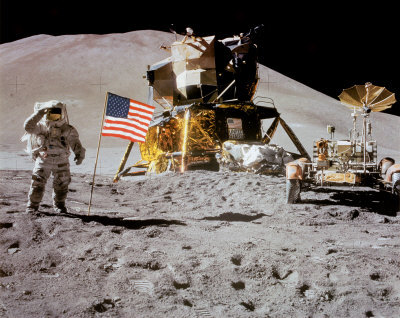
Space Technology 


                                   Landing on the Moon, 1969 


The Jet Propulsion Laboratory (JPL), headquartered in Pasadena, is managed by the California Institute of Technology for NASA. The Jet Propulsion Laboratory was the birthplace of the American space program and plays a prominent role in its continuation.  http://www.jpl.nasa.gov/
The Laboratory's primary function is the construction and operation of robotic planetary spacecraft, though it also conducts Earth-orbit and astronomy missions. Among the Laboratory's current projects are a mission to Saturn and the Mars Reconnaissance Orbiter. 

Suggested moderator: : K. Anthony Appiah, is currently the Laurance S. Rockefeller University Professor of Philosophy at Princeton University. He is a philosopher,  cultural theorist and novelist. 

CONCLUSION: I believe that above panel addresses the issue of  "How LA 
Invented the World," and would provide the audience with some thoughts 
worth considering and discussing further. It is not planned as an entertainment, 
rather as encouraging intellectual speculation.


Thursday, December 1, 2011

Occupy LA Rebounds Mightily


I just returned from the post-police raid Occupy LA General
Assembly which convened, with permission from the mayor,
at 7:30pm on the west steps of City Hall. Approximately 200
people sat on the steps in clusters of ten, forming some 20
affinity groups with the same agenda: "what do we do next?"

When it came time for reports from each group, there was
no rehashing the events of the previous day. Every person
who spoke was clear, focused and articulate. They accepted
dismantling the City Hall encampment as signaling the need
to move forward in different directions. One common theme
emerged from virtually every report - the need to decentralize
and reach out to neighborhoods across LA taking the "we are
the 99%" message to as many people as possible.

Because some familiar faces were missing, there must have
been a previous decision for certain people to get arrested
while others did not in order to have a core group who could
maintain momentum. Apparently, the need for horizontal
decision-making must have been  abandoned temporarily.

I left this meeting more hopeful than ever before recognizing
that the Occupy LA movement is not only resilient, it is dynamic.

Wednesday, November 30, 2011

LAPD Removes Occupy LA from City Hall Park


Above: Sunday evening, November 28, three thousand people 
gather in support of Occupy LA at its site in City Hall Park. Not
visible, I am seated on the ground behind the woman in the rose
colored sweater in the center left. Below: In the wake of the LAPD
raid the night before, on Wednesday morning, November 30, a 
sanitation worker is clearing the steps in front of City Hall. 


What Occupy LA Meant to Me
I am chagrined to see it disappear - hopefully momentarily. For
me, it represented a breath of fresh air in our society which has
been overwhelmed by greed and indifference. Occupy LA was
one of many such encampments around the globe inspired by
Occupy Wall Street in Lower Manhattan. The movement's slogan,
"We are the 99%," resonated and needed no explanation. For
everyone, there was no question of "which side you are on."
Those of us who would welcome social change were inspired;
those who want to see the imbalance continue were threatened.
Social revolutions are long term affairs: evolving, contracting
and finally blossoming.

There is no question in my mind that we are seeing only the
beginning of the Occupy movement that might morph into
something more enduring. Although the Occupy movements
disdain vertical leadership, there is a cadre of people called
"point persons," who have emerged with knowledge and
experience; hopefully, they will not disappear, nor will they be
co-opted by the system that they abhor. Organized labor, which
has been marginalized, sees a potential for itself in aligning
with the Occupy movements. Hopefully, together they will be
able to sustain the momentum that has evolved to date. However,
I fear that the repressive apparatus of the FBI and Homeland
Security clearly wants to extinguish any vestige of the occupy
movement. Hopefully, they will not succeed. I sense that we are
moving into a period of dramatic and exciting social change which
will influence the lives of generations to come.

While it lasted, Occupy LA was an integral part of my life and
consequently, my wife, Mary's life. (Below, Mary is not sleeping; 
she is relaxed in reverie.)


For us, Occupy LA symbolized the idealism of the hippie movement
of the 60s and 70s which was so identified with our lives.


Adopting a logo design by Tracy Fink, I was able to get
American Apparel to provide us with 200 printed tee
shirts. They disappeared in five minutes.

Tuesday, November 22, 2011

How Los Angeles Invented the World

January 19,  2011 at The Getty Center
A program of Pacific Standard Time: Art in LA. 1945-1980
http://www.pacificstandardtime.org/

A shuffled replay of this event can be seen: http://zocalopublicsquare.org/thepublicsquare/2011/11/20/was-ever-a-city-more-bewildering/read/the-takeaway/


Panel One - How Los Angeles Created the Good Life


There were three panelists and a moderator - dull / pedantic academics who,
except for one, the curator of photographs at The Huntington Library, exhibited
the enthusiasm of dead fish. The Huntington curator was allowed to show two
photos similar to the one below which demonstrated the innovative Southern
California indoor/outdoor informal life style of the post World War II period
which has since been adapted across America.

Of the three panel discussions, this is the only one which addressed the theme:
"How Los Angeles Invented the World."


Had The Huntington photo curator been allowed to play two minutes of  The
Mammas and the Papas "California Dreamin" as an accompaniment to her slides -

" all the leaves are brown
  And the sky is grey
  I went for a walk 
  On a winter's day 
  I'd be safe and warm 
  If i was in l.a. 
  California dreamin' 
  On such a winter's day" 

there would have been no need for anyone to say another word. The audience
would have been spared thirty minutes of boredom.

Unfortunately, no one mentioned another Pacific Standard Time event, an
excellent exhibition at the Los Angeles County Museum of Art,  "California
Design, 1930-1965: Living in a Modern Way," which documents in well-
organized detail the work of the artists and designers who contributed to this
new vision.
http://www.lacma.org/art/exhibition/californiadesign

Granted that LA today is one of the most ethnically diverse cities in the world,
it was hard to figure out why ethnicity entered the picture. East coast cities like
New York and Philadelphia, plus midwestern Chicago, had long ago established
America's urban multiculturalism with its concomitant ability to accomodate
minority cultures. It took a question from the audience to draw attention to the
long burning issue of restrictive housing codes that were endemic in pre-World
War II LA neighborhoods - with the exception of Boyle Heights which embraced
a highly diverse population of immigrants including Jews, Japanese and Mexicans.

At the conclusion of this session, I don't think that anyone in the audience had
learned a thing about "How Los Angeles Created the Good Life" that he/she did
not already know.

Panel Two - How Life Imitated Art


Because of all the local boosterism, I thought that I had been parachuted into a
luncheon of the Indianapolis Chamber of Commerce; however, I loved every minute
of this one.  It was loaded with an incredible group of extremely talented people
who live and work in LA. For them, LA serves as an ideal background for films,
which is their business. They were: director William Friedkin, critic Richard Schickel,
critic Kenneth Turan, and writer/director Thom Andersen. Reed Johnson of the
Los Angeles Times was moderator.  They considered the inherent instability of the
environment to be one of LA's challenging attributes. Although they alluded to an
LA sensibility, they did not define it. They contrasted the LA image of optimism
with the LA noir image, which they considered equally valid. For them, "Blade
Runner" was an iconic LA film.

Had they addressed the announced theme, "How Los Angeles Invented the World,"
they might have expanded on their contention that Hollywood is the world capital of
film. Had they addressed the announced theme, they might have brought attention to
celebrity culture, the chief product manufactured in LA. There were allusions to
television and cable, but no mention of tv commercials, a local product that influences
more attitudes than movies. Had they addressed the announced theme, they might have
alluded to the space program which was born in Pasadena, a part of Greater LA.

Panel Three - The Past and the Future of LA's Global Image


Another luncheon at the Indianpolis Chamber of Commerce with a panel of brilliant,
creative people. Warren Olney of KCRW was moderator. Panelists were: director
Wim Wenders, director John Singelton, essayist Richard Rodriguez and architect
Eric Owen Moss. How can you not love and enjoy a gab fest with such people? I
don't think that they addressed the announced themes any more so than the previous
panelists, and I don't think that I retain any great ideas expounded here, but, again,
I loved every minute of it.

My conclusions 
It is not easy to run a panel discussion with a bunch of high-powered independent
people; however, there are some methodologies that are often used to keep panelists
focused on the themes to be discussed. I had a good time, but I would have learned
more, which is the reason that I went, if there had been some thematic discipline
evident. It was great entertainment, but not a lot of learning!


This event reinforced New York intellectuals' perception of LA as a place where
entertainment predominates and substance is slight. Overall, I would say that the
organizers of this event blew it. They failed to make a case that LA is beyond fluff.