http://www.nytimes.com/2015/08/20/arts/design/what-i-learned-from-a-disgraced-art-show-on-harlem.html? hp&action=click&pgtype=Homepage&module=mini-moth®ion=top-storiebelow&WT.nav=top-stories
Having been the person who created the idea of the Harlem On My Mind exhibition, sold it
to Tom Hoving, then Director of The Metropolitan Museum of Art, and who served as curator, lead exhibition designer and author of the book which was the exhibition catalog, I want to clarify one issue. Harlem On My Mind was never conceived of nor presented as a traditional art museum exhibition.

Above: Samuel F.B. Morse, Gallery of the Louvre (1831–1833). Here we can see the 19th Century art museum convention of hanging paintings against flat surfaces. In the 20th and 21st centuries, this paradigm, with less clutter, persists. This static mode of museum presentation represented the convention that Harlem On My Mind hoped to alter. In my Introduction to the catalogue, I state: “ … the Metropolitan Museum’s exhibition and this book - document the struggle to establish an urban black culture …” The Harlem On My Mind exhibition was conceived as what I called “a communications environment.” I described it as a place in which visual and aural media were utilized to convey messages.
In the late 1950s, the transformation of the exhibition visitors' experience was on the minds of architects and designers. For the Philips electronic giant's pavilion at the 1958 Brussels World's Fair, Le Corbusier designed "The Electronic Poem," a structure in which to
experience a scripted presentation of the music of avant-garde composer Edgar Varèse
enhanced by light, color, sound, rhythm, and images.

Le Corbusier, "The Electronic Poem," Brussels, 1958
In 1952, designers George Nelson, Charles Eames and Alexander Girard experimented with a teaching program at the University of Georgia where they created spaces that incorporated projected images, sound and odors, At that time, I was producing television programs for the San Francisco Museum of Modern Art. That experience helped me formulate my own philosophy of exhibition design. Multi-media presentations were the core of exhibitions that Eames and Nelson designed for the Moscow International Exposition in 1959 and the New York World's Fair in 1964.


Above: Samuel F.B. Morse, Gallery of the Louvre (1831–1833). Here we can see the 19th Century art museum convention of hanging paintings against flat surfaces. In the 20th and 21st centuries, this paradigm, with less clutter, persists. This static mode of museum presentation represented the convention that Harlem On My Mind hoped to alter. In my Introduction to the catalogue, I state: “ … the Metropolitan Museum’s exhibition and this book - document the struggle to establish an urban black culture …” The Harlem On My Mind exhibition was conceived as what I called “a communications environment.” I described it as a place in which visual and aural media were utilized to convey messages.
In the late 1950s, the transformation of the exhibition visitors' experience was on the minds of architects and designers. For the Philips electronic giant's pavilion at the 1958 Brussels World's Fair, Le Corbusier designed "The Electronic Poem," a structure in which to
experience a scripted presentation of the music of avant-garde composer Edgar Varèse
enhanced by light, color, sound, rhythm, and images.

Le Corbusier, "The Electronic Poem," Brussels, 1958
In 1952, designers George Nelson, Charles Eames and Alexander Girard experimented with a teaching program at the University of Georgia where they created spaces that incorporated projected images, sound and odors, At that time, I was producing television programs for the San Francisco Museum of Modern Art. That experience helped me formulate my own philosophy of exhibition design. Multi-media presentations were the core of exhibitions that Eames and Nelson designed for the Moscow International Exposition in 1959 and the New York World's Fair in 1964.

Multi-screen projections. Moscow International
Exposition, 1959. Office of Charles and Ray Eames.
I had written extensively for art journals presenting my philosophy. I quote from MUSEUM, a
quarterly journal published by Unesco, Volume XXIII, No. 3 1970/71. "This is the age of electronic
communication ... Like much else in our lives, it is revolutionizing museums ... Through communications, art museums will have to offer indirect experience ... the idea of the museum as a place of silent contemplation is vanishing ... People are immersed in transmitted fact ... Participation implies more effective communication ... No one is compelled to accept or rely on any one source, but can for his/her purposes make his/her own selection ... a museum exhibition offers a mass of images and sounds which can convey unique and differentiated messages to differentiated individuals within a mass audience."
In 1966, The Lower East Side exhibition at The Jewish Museum provided me with an opportunity to implement my philosophy - redefining the museum experience from observation to participation.


Top: Book dust jacket, 1967. Second from top: "The Lower East Side: Portal to American Life," The
Jewish Museum, New York, 1966. It was New York's second "Blockbuster exhibition.""The Family of Man," a photographic exhibition at the Museum of Modern Art, 1955, was the first. At The Jewish Museum, the line extended from Fifth Avenue and 92nd Street to Madison Avenue. Third from top: Crowds watching a film of Zero Mostel's reading "Bintel Briefs," letters to the Editor of the Jewish Daily Forward. Bottom; Close up of watching film of Zero Mostel's reading "Bintel Briefs."
Regretfully, from my perspective, this exhibition had one gallery devoted to the work of "Ash Can School" painters. The then- Jewish Museum director dictated its inclusion. I always saw it as a discordant note and chose not to include paintings, prints and sculpture in the Harlem On My Mind exhibition because doing so would have violated my personal aesthetic. Unfortunately, the exclusion of works of art became a contentious issue with black Harlem artists. Being aware of and sensitive to their resentment, I proposed that The Met host a parallel exhibition of black artists in adjacent galleries. Tom Hoving endorsed my proposal and assigned a novice staff member whose responsibility was community affairs to implement this project. The Met staff, totally inexperienced in dealing with groups other than their established predominantly white upper class constituency, bungled. Thus, my innovative project which opened the doors and galleries of The Met to minority cultures was tarnished by events over which I had no control. However, it must be said in all honesty with regard to the issue of dealing with Harlem artists, there were no precedents to draw on and few professionals with experience and knowledge.
In addition to the accusation that the exhibition staff was all white and that we had no community
input, I offer photos and bios of two prominent members of the exhibition staff: Don Harper and Reginald McGhee, and a list of the members of the community advisory committee. Mel Patrick,
Harlem resident and senior staff member of African-American Borough President, Percy Sutton's
administration, was the exhibition's community coordinator. The staff consulted with this committee
periodically hearing both approval and criticism. Footnote: Community Advisory Committee Member Arnold Johnson was appointed to the Board of Directors of The Metropolitan Museum of Art.


Above left: Don Harper was associate researcher and media director. He was an electrical engineer who moved into the field of multi-media communication. He participated in creating March on Selma, a documentary exhibition which coordinated taped-interviews with photographs by Bruce Davidson. Above right: Reginald McGhee, director of photographic research, was a professional
photojournalist whose work had appeared nationally in newspapers and periodicals.
Don Harper, Reginald McGhee and A'lelia Nelson, a third African American member of the exhibition staff, reviewed and exercised final authority over every photo, film, slide, recorded interview, musical recording and text panel included in the exhibition.
The Harlem On My Mind exhibition transformed art museums around the world which at time
were stolid silent environments dedicated to the interests of a privileged few. There was brutal resistance to Harlem On My Mind in the media. Art critics hated the noise and asked, "Where's the art?" In the wake of a negative story that broke in The New York Times prior to the exhibition's opening Martha Wallace, a veteran of Time Life and president of the Henry R. Luce Foundation, funders of the exhibition, predicted that the die had been cast and that the exhibition would be perceived with negativity. Her projection holds true until today.
Beyond the media, there was more unforgiving resentment. A distinguished Columbia University art history professor had the audacity to send Tom Hoving a letter in which he deplored Hoving's decision to host this exhibition at Fifth Avenue and 82nd Street. He said that it "belonged in an armory in Harlem."
First and foremost Harlem On My Mind dignified the culture of an ethic minority in the United States encouraging them to visit a bastion of high culture where their story was being told with honesty.
At that time, art museums around the world presented the art of ethnic people as "Primitive Art."
The then Museum of Primitive Art stood on West 54th Street facing the Museum of Modern Art garden. Secondly, Harlem On My Mind transformed the museum environment. For the first time,
it was not an 19th Century, or perhaps Third Century B.C. contemplative environment. It was an interactive space reflective of the burgeoning electronic communications culture of the late 20th century. Although radically new in 1969, the museum as an interactive communications environment has become conventional. Tom Hoving always supported my transformational concept.
I envisioned the Harlem On My Mind exhibition as a walk through cinematic experience utilizing photographic enlargements, film, video, slide projections, text panels with accompanying sound: music and recorded interviews. The exhibition was divided into six chronological sections. Each section was designed to simulate the time period portrayed and had a different appearance with physical characteristics evocative of the chronological period being portrayed. Museum visitors were barraged with visual and aural information and were encouraged to become active participants in processing the information presented.
My conception of a museum exhibition as "a walk through cinematic experience" was very much in the spirit of communication theorists of that time. In 1953, Charles and Ray Eamesreleased their film, A Communications Primer.
https://www.youtube.com/watch?v=byyQtGb3dvA
Their objective was to enhance appreciation of the broad meaning of “communication” and to advocate the breakdown of barriers between various disciplines. They wanted to interpret and present current ideas on communications theory to architects and planners in an understandable way that would encourage their use of communications theory as tools in planning and design.
Marshall McCluhan's 1964 book The Medium Is The Message, embodied a response to the avalanche of information that was beginning to inundate the daily lives of most people. Since the 1920s, radio
had been an accepted medium of popular culture. When television arrived on the scene in the 1950s,
it transformed the personal experience of ingesting information. McCluhan was anointed as the prophet of the new age of communication. Here, he describes his concept of "The World is a Global Village."
https://www.youtube.com/watch?v=HeDnPP6ntic
Following in the footsteps of Charles and Ray Eames, Marshall McCluhan and George Nelson, it was my objective to create a totally new type of museum exhibition experience.
Exposition, 1959. Office of Charles and Ray Eames.
I had written extensively for art journals presenting my philosophy. I quote from MUSEUM, a
quarterly journal published by Unesco, Volume XXIII, No. 3 1970/71. "This is the age of electronic
communication ... Like much else in our lives, it is revolutionizing museums ... Through communications, art museums will have to offer indirect experience ... the idea of the museum as a place of silent contemplation is vanishing ... People are immersed in transmitted fact ... Participation implies more effective communication ... No one is compelled to accept or rely on any one source, but can for his/her purposes make his/her own selection ... a museum exhibition offers a mass of images and sounds which can convey unique and differentiated messages to differentiated individuals within a mass audience."
In 1966, The Lower East Side exhibition at The Jewish Museum provided me with an opportunity to implement my philosophy - redefining the museum experience from observation to participation.


Top: Book dust jacket, 1967. Second from top: "The Lower East Side: Portal to American Life," The
Jewish Museum, New York, 1966. It was New York's second "Blockbuster exhibition.""The Family of Man," a photographic exhibition at the Museum of Modern Art, 1955, was the first. At The Jewish Museum, the line extended from Fifth Avenue and 92nd Street to Madison Avenue. Third from top: Crowds watching a film of Zero Mostel's reading "Bintel Briefs," letters to the Editor of the Jewish Daily Forward. Bottom; Close up of watching film of Zero Mostel's reading "Bintel Briefs."
Regretfully, from my perspective, this exhibition had one gallery devoted to the work of "Ash Can School" painters. The then- Jewish Museum director dictated its inclusion. I always saw it as a discordant note and chose not to include paintings, prints and sculpture in the Harlem On My Mind exhibition because doing so would have violated my personal aesthetic. Unfortunately, the exclusion of works of art became a contentious issue with black Harlem artists. Being aware of and sensitive to their resentment, I proposed that The Met host a parallel exhibition of black artists in adjacent galleries. Tom Hoving endorsed my proposal and assigned a novice staff member whose responsibility was community affairs to implement this project. The Met staff, totally inexperienced in dealing with groups other than their established predominantly white upper class constituency, bungled. Thus, my innovative project which opened the doors and galleries of The Met to minority cultures was tarnished by events over which I had no control. However, it must be said in all honesty with regard to the issue of dealing with Harlem artists, there were no precedents to draw on and few professionals with experience and knowledge.
In addition to the accusation that the exhibition staff was all white and that we had no community
input, I offer photos and bios of two prominent members of the exhibition staff: Don Harper and Reginald McGhee, and a list of the members of the community advisory committee. Mel Patrick,
Harlem resident and senior staff member of African-American Borough President, Percy Sutton's
administration, was the exhibition's community coordinator. The staff consulted with this committee
periodically hearing both approval and criticism. Footnote: Community Advisory Committee Member Arnold Johnson was appointed to the Board of Directors of The Metropolitan Museum of Art.


photojournalist whose work had appeared nationally in newspapers and periodicals.
The Harlem On My Mind exhibition transformed art museums around the world which at time
were stolid silent environments dedicated to the interests of a privileged few. There was brutal resistance to Harlem On My Mind in the media. Art critics hated the noise and asked, "Where's the art?" In the wake of a negative story that broke in The New York Times prior to the exhibition's opening Martha Wallace, a veteran of Time Life and president of the Henry R. Luce Foundation, funders of the exhibition, predicted that the die had been cast and that the exhibition would be perceived with negativity. Her projection holds true until today.
Beyond the media, there was more unforgiving resentment. A distinguished Columbia University art history professor had the audacity to send Tom Hoving a letter in which he deplored Hoving's decision to host this exhibition at Fifth Avenue and 82nd Street. He said that it "belonged in an armory in Harlem."
First and foremost Harlem On My Mind dignified the culture of an ethic minority in the United States encouraging them to visit a bastion of high culture where their story was being told with honesty.
At that time, art museums around the world presented the art of ethnic people as "Primitive Art."
The then Museum of Primitive Art stood on West 54th Street facing the Museum of Modern Art garden. Secondly, Harlem On My Mind transformed the museum environment. For the first time,
it was not an 19th Century, or perhaps Third Century B.C. contemplative environment. It was an interactive space reflective of the burgeoning electronic communications culture of the late 20th century. Although radically new in 1969, the museum as an interactive communications environment has become conventional. Tom Hoving always supported my transformational concept.
I envisioned the Harlem On My Mind exhibition as a walk through cinematic experience utilizing photographic enlargements, film, video, slide projections, text panels with accompanying sound: music and recorded interviews. The exhibition was divided into six chronological sections. Each section was designed to simulate the time period portrayed and had a different appearance with physical characteristics evocative of the chronological period being portrayed. Museum visitors were barraged with visual and aural information and were encouraged to become active participants in processing the information presented.
My conception of a museum exhibition as "a walk through cinematic experience" was very much in the spirit of communication theorists of that time. In 1953, Charles and Ray Eamesreleased their film, A Communications Primer.
https://www.youtube.com/watch?v=byyQtGb3dvA
Their objective was to enhance appreciation of the broad meaning of “communication” and to advocate the breakdown of barriers between various disciplines. They wanted to interpret and present current ideas on communications theory to architects and planners in an understandable way that would encourage their use of communications theory as tools in planning and design.
Marshall McCluhan's 1964 book The Medium Is The Message, embodied a response to the avalanche of information that was beginning to inundate the daily lives of most people. Since the 1920s, radio
had been an accepted medium of popular culture. When television arrived on the scene in the 1950s,
it transformed the personal experience of ingesting information. McCluhan was anointed as the prophet of the new age of communication. Here, he describes his concept of "The World is a Global Village."
https://www.youtube.com/watch?v=HeDnPP6ntic
Following in the footsteps of Charles and Ray Eames, Marshall McCluhan and George Nelson, it was my objective to create a totally new type of museum exhibition experience.

The majority of Harlem's current housing stock, brownstones and apartments, was constructed at the
end of the 19th century and the beginning of the 20th Century. The completed subway and elevated lines made, what had been an undeveloped rural area, into Manhattan's northernmost residential neighborhood. At that time, the residents were predominantly white: German, Irish, Italian and Jewish. When the then established Midtown Manhattan African American neighborhood was displaced by construction of Pennsylvania Station, Blacks moved North. It was not until The Great Migration following World War I that Blacks became the majority of Harlem residents.


Top, Woman with Surrey, c. 1900. Second from top: Armistice Day, 1919, Lenox Avenue and 134th Street. Second from bottom: Apartment houses, West 134th Street, c. 1915.
As seen above, there was a slide projector presentation at the entrance to each gallery. The information viewed here defined the time period. Some photo enlargements presented life-size images. The objective was to encourage gallery visitors to project themselves into the subject of the image, thus becoming active participants in the gallery experience. Amplified recorded sound: music and recorded interviews were integral to each gallery.


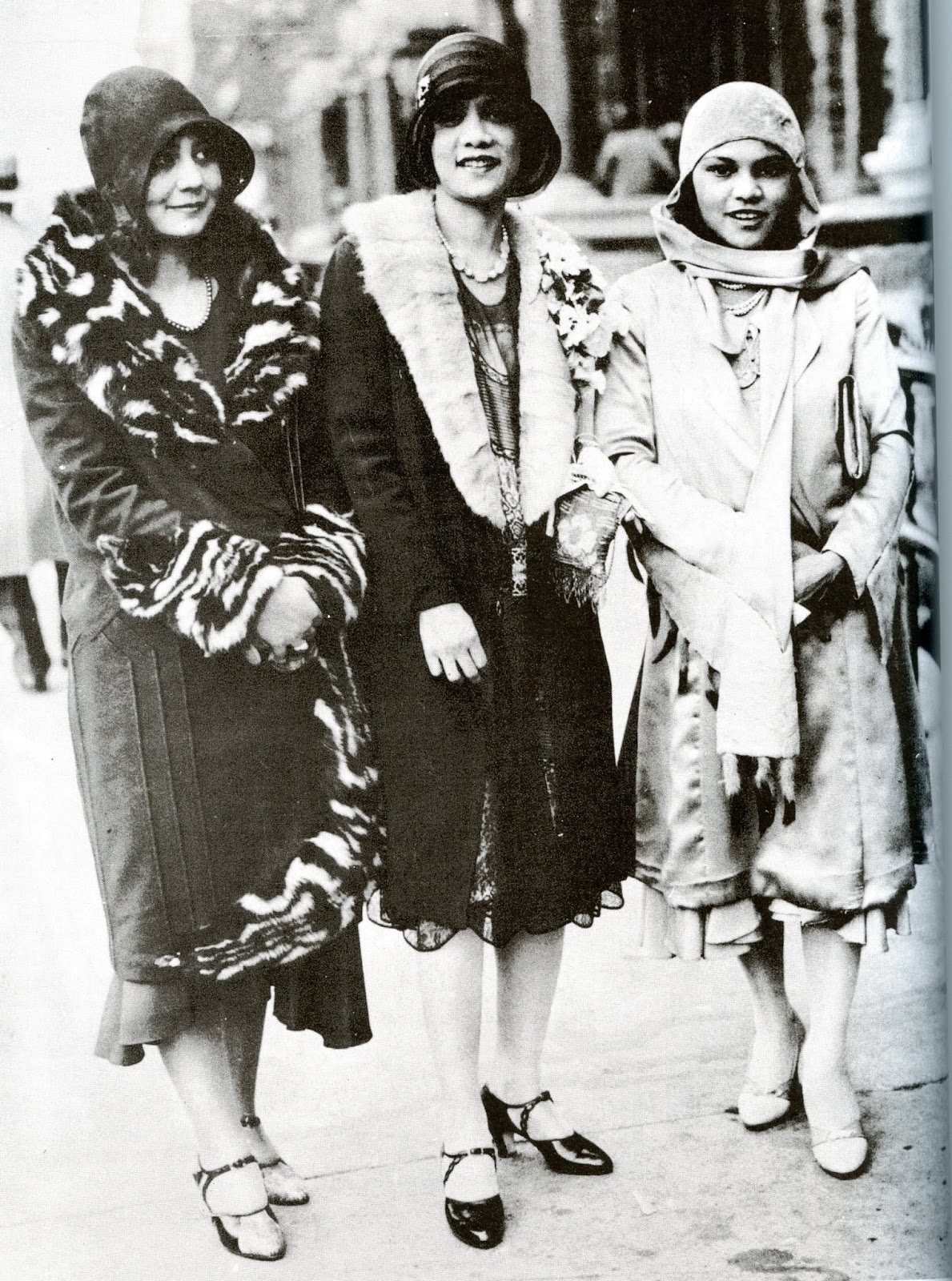


Top, "The Gay Northeasterners, strolling down Lenox Avenue, c. 1929. Second from top, Marcus Garvey, c. 1925. Third from the top, title page of a book by Claude McKay. Second from the bottom, Cotton Club poster, c. 1928. Bottom: Ethel Waters, "Am I Blue?" From the musical, "On With The Show," 1929.
Enterprising African American bourgeoisie from across the country gravitated to Harlem creating a neighborhood of talented and entrepreneurial people who would rival others in NewYork City with its cadre of creative and stylish individuals. This was the period of "The Cotton Club" which showcased Black entertainment talent, "Harlem jazz" which developed its own personality, and the "The Harlem Renaissance," a coterie of artists and writers who would define the era through their personal creativity,
There were huge enlargements of James VanDerZee's classically beautiful photographs of the neighborhood and its residents, one of which was enlarged to 12 x 50 feet. The voice of Marcus Garvey, a major political force in the 1920s, could be heard as one viewed the above life-size photo. There was another gallery in which recorded music could be heard and record labels were projected on panels suspended just below its forty-foot ceiling." Harlem was in vogue!"


Top: Simulation of a "Bread Line where hungry people congregated to obtain food for themselves
and their families. Middle: .Nuns offering food to children, c. 1931. Bottom: Civil disturbance, 1935.
It was called "The Great Depression" and it began with the stock market crash of October 1929. It
lasted until preparation for America's participation in WorldWar II commenced. Blacks in Harlem suffered more than whites in other new York City neighborhoods. Life was difficult for everyone in
Harlem. Beyond that, civil disturbances erupted.
It was also the period in which Harlem musicians and Harlem jitterbugging went national.


Top: Ben Webster, left and Billie Holliday, center, 1935. Bottom: Jitterbugging at the Savoy. 1939.


The New York Times, April 20, 1941
TWO BUS LINES AGREE TO
EMPLOY NEGROES
The New York Age, November 15, 1941
POWELL WINS COUNCIL SEAT
The New York Age, September 15, 1942
MARCH THREAT BY RANDOLPH
The New York Age, June 12,1943
WAR JOBS OPEN TO NEGROES
The New York Age, August 5, 1944
ADAM CLAYTON POWELL, JR.
BECOMES FIRST CONGRESSMAN
Amsterdam News, June23,1945
STATE FEPC OUTGROWTH OF
RIOTS, RELIEF AND REFORM
The New York Times, January 28, 1948
ETHICS CODE SET UP BY HARLEM
STORES
The New Yorker, July 3, 1948
PROFILES: BOP

WAR JOBS OPEN TO NEGROES
The New York Age, August 5, 1944
ADAM CLAYTON POWELL, JR.
BECOMES FIRST CONGRESSMAN
Amsterdam News, June23,1945
STATE FEPC OUTGROWTH OF
RIOTS, RELIEF AND REFORM
The New York Times, January 28, 1948
ETHICS CODE SET UP BY HARLEM
STORES
The New Yorker, July 3, 1948
PROFILES: BOP


The New York Times, September 14, 1950
MORE "MILITANCY" BY NEGROES
URGED
Amsterdam News, January 6, 1951
HARLEM LEFT OUT OF A-BOMB
SHELTER PLANS
The New York Times, January 22, 1954
NEGROES FORCED TO SELL
LONG ISLAND HOME
Amsterdam News, August 2, 1958
NRUMAH: WE'RE BROTHERS
Amsterdam News, July 11, 1959
HOUSING FIGHT: REVOLT
SPREADS


To reflect the spirit of the 1960s, there was elongated gallery with a multi-media presentation of four image projections on each wall, a total of eight with one dedicated to each year of the decade. There were images alternating with headlines. The sound accompaniment was vigorous rock. The amplifier controls were located outside the office of the Curator of Greek and Roman Art. He insisted on turning down the volume. An exhibition staff member made constant adjustments.

Top: National Memorial African Bookstore on 125th Street
Amsterdam News, August 6, 1960
8,500 CROWD ARMORY TO HEAR
MUHAMMAD
The New York Times, December 2, 1963
MALCOLM X LIKENS SLAYINGS TO
"CHICKENS COMNG HOME TO ROOST"
"Malcolm X, a leader of the Black Muslims, yesterday characterized the assassination of President Kennedy as an instance of the 'chickens coming home to roost...' There was loud applause and laughter."
Amsterdam News, July 11, 1959
HOUSING FIGHT: REVOLT
SPREADS
The New York Times, July 19, 1964
NEGRO BOY KILLED: 300 HARRASS
POLICE
Amsterdam News, July 25, 1964
THREE VIOLENT DAYS: SATURDAY
NIGHT, SUNDAY NIGHT
Amsterdam News, September 3, 1966
BLACK PANTHERS OPEN HARLEM
DRIVE
Amsterdam News, May 1, 1968
HARLEM BACKED COLUMBIA STUDENTS
"The Harlem community rallied in aid and defense of the Black Columbia University
students who took over Hamilton Hall ... Daily, since more than 150 Black students laid siege,
Harlemites visited them behind their barricaded doors, advised them, gave them moral support,
food and money."

"THE HALL OF HARLEM HEROES"
The last gallery of the exhibition was forty enlarged portraits of the famous alongside everyday residents of Harlem.
Did the exhibition and its accompanying catalogue achieve their objectives: dignifying the lives of African Americans and telling the story of Harlem as the cultural capital of Black America with honesty?

James VanDerZee and his wife, 1930
"In my estimation Harlem On My Mind represents months and years of research ... It should be considered a history of the times; it is important for the present generation and coming generations...
No household, school or library should be without it."
James VanDerZee
"In Harlem On My Mind one witnesses it all - the joys, sorrows, and triumphs of this mecca of black achievement ... Harlem as it was in early 1900's, as it is today and what one might expect from it in the future. It is an important contribution, not only to the history of Harlem but to the history of America as well."
Gordon Parks
"... one of the richest and most comprehensive records of the history of the African American in the
twentieth century."
Henry Louis Gates, Jr.
Both photography curator Deborah Willis and photographer Dawoud Bey said that seeing enlarged, dignified photographs of African Americans in The Metropolitan Museum of Art, encouraged them to enter the field of photography.
An eye witness report
The Harvard Crimson, February 5, 1969
http://www.thecrimson.com/article/1969/2/5/harlem-on-my-mind-pbwbhen-my/
Footnote:
The art scene in New York in the 1960s was an exciting and inventive climate. Grace Glueck, then art critic of The New York Times, told me that she thought that: “... a new art movement was invented every day.” My exhibitions were products of that environment. The following provide testimony to that particular time, as well as my participation in its dynamics.
http://www.nytimes.com/2015/11/08/arts/design/the-big-bang-of-art-and-tech-in-new-york.html?_r=
This site was created by cultural historian, writer, and curator, Allon Schoener. He was responsible for organizing, designing and producing the Harlem On My Mind exhibition at The Metropolitan Museum of Art in 1969. He was author of the book which served as its catalogue, now in its fourth printing.
This site was created by cultural historian, writer, and curator, Allon Schoener. He was responsible for organizing, designing and producing the Harlem On My Mind exhibition at The Metropolitan Museum of Art in 1969. He was author of the book which served as its catalogue, now in its fourth printing.