Wednesday, November 30, 2011

LAPD Removes Occupy LA from City Hall Park


Above: Sunday evening, November 28, three thousand people 
gather in support of Occupy LA at its site in City Hall Park. Not
visible, I am seated on the ground behind the woman in the rose
colored sweater in the center left. Below: In the wake of the LAPD
raid the night before, on Wednesday morning, November 30, a 
sanitation worker is clearing the steps in front of City Hall. 


What Occupy LA Meant to Me
I am chagrined to see it disappear - hopefully momentarily. For
me, it represented a breath of fresh air in our society which has
been overwhelmed by greed and indifference. Occupy LA was
one of many such encampments around the globe inspired by
Occupy Wall Street in Lower Manhattan. The movement's slogan,
"We are the 99%," resonated and needed no explanation. For
everyone, there was no question of "which side you are on."
Those of us who would welcome social change were inspired;
those who want to see the imbalance continue were threatened.
Social revolutions are long term affairs: evolving, contracting
and finally blossoming.

There is no question in my mind that we are seeing only the
beginning of the Occupy movement that might morph into
something more enduring. Although the Occupy movements
disdain vertical leadership, there is a cadre of people called
"point persons," who have emerged with knowledge and
experience; hopefully, they will not disappear, nor will they be
co-opted by the system that they abhor. Organized labor, which
has been marginalized, sees a potential for itself in aligning
with the Occupy movements. Hopefully, together they will be
able to sustain the momentum that has evolved to date. However,
I fear that the repressive apparatus of the FBI and Homeland
Security clearly wants to extinguish any vestige of the occupy
movement. Hopefully, they will not succeed. I sense that we are
moving into a period of dramatic and exciting social change which
will influence the lives of generations to come.

While it lasted, Occupy LA was an integral part of my life and
consequently, my wife, Mary's life. (Below, Mary is not sleeping; 
she is relaxed in reverie.)


For us, Occupy LA symbolized the idealism of the hippie movement
of the 60s and 70s which was so identified with our lives.


Adopting a logo design by Tracy Fink, I was able to get
American Apparel to provide us with 200 printed tee
shirts. They disappeared in five minutes.

Tuesday, November 22, 2011

How Los Angeles Invented the World

January 19,  2011 at The Getty Center
A program of Pacific Standard Time: Art in LA. 1945-1980
http://www.pacificstandardtime.org/

A shuffled replay of this event can be seen: http://zocalopublicsquare.org/thepublicsquare/2011/11/20/was-ever-a-city-more-bewildering/read/the-takeaway/


Panel One - How Los Angeles Created the Good Life


There were three panelists and a moderator - dull / pedantic academics who,
except for one, the curator of photographs at The Huntington Library, exhibited
the enthusiasm of dead fish. The Huntington curator was allowed to show two
photos similar to the one below which demonstrated the innovative Southern
California indoor/outdoor informal life style of the post World War II period
which has since been adapted across America.

Of the three panel discussions, this is the only one which addressed the theme:
"How Los Angeles Invented the World."


Had The Huntington photo curator been allowed to play two minutes of  The
Mammas and the Papas "California Dreamin" as an accompaniment to her slides -

" all the leaves are brown
  And the sky is grey
  I went for a walk 
  On a winter's day 
  I'd be safe and warm 
  If i was in l.a. 
  California dreamin' 
  On such a winter's day" 

there would have been no need for anyone to say another word. The audience
would have been spared thirty minutes of boredom.

Unfortunately, no one mentioned another Pacific Standard Time event, an
excellent exhibition at the Los Angeles County Museum of Art,  "California
Design, 1930-1965: Living in a Modern Way," which documents in well-
organized detail the work of the artists and designers who contributed to this
new vision.
http://www.lacma.org/art/exhibition/californiadesign

Granted that LA today is one of the most ethnically diverse cities in the world,
it was hard to figure out why ethnicity entered the picture. East coast cities like
New York and Philadelphia, plus midwestern Chicago, had long ago established
America's urban multiculturalism with its concomitant ability to accomodate
minority cultures. It took a question from the audience to draw attention to the
long burning issue of restrictive housing codes that were endemic in pre-World
War II LA neighborhoods - with the exception of Boyle Heights which embraced
a highly diverse population of immigrants including Jews, Japanese and Mexicans.

At the conclusion of this session, I don't think that anyone in the audience had
learned a thing about "How Los Angeles Created the Good Life" that he/she did
not already know.

Panel Two - How Life Imitated Art


Because of all the local boosterism, I thought that I had been parachuted into a
luncheon of the Indianapolis Chamber of Commerce; however, I loved every minute
of this one.  It was loaded with an incredible group of extremely talented people
who live and work in LA. For them, LA serves as an ideal background for films,
which is their business. They were: director William Friedkin, critic Richard Schickel,
critic Kenneth Turan, and writer/director Thom Andersen. Reed Johnson of the
Los Angeles Times was moderator.  They considered the inherent instability of the
environment to be one of LA's challenging attributes. Although they alluded to an
LA sensibility, they did not define it. They contrasted the LA image of optimism
with the LA noir image, which they considered equally valid. For them, "Blade
Runner" was an iconic LA film.

Had they addressed the announced theme, "How Los Angeles Invented the World,"
they might have expanded on their contention that Hollywood is the world capital of
film. Had they addressed the announced theme, they might have brought attention to
celebrity culture, the chief product manufactured in LA. There were allusions to
television and cable, but no mention of tv commercials, a local product that influences
more attitudes than movies. Had they addressed the announced theme, they might have
alluded to the space program which was born in Pasadena, a part of Greater LA.

Panel Three - The Past and the Future of LA's Global Image


Another luncheon at the Indianpolis Chamber of Commerce with a panel of brilliant,
creative people. Warren Olney of KCRW was moderator. Panelists were: director
Wim Wenders, director John Singelton, essayist Richard Rodriguez and architect
Eric Owen Moss. How can you not love and enjoy a gab fest with such people? I
don't think that they addressed the announced themes any more so than the previous
panelists, and I don't think that I retain any great ideas expounded here, but, again,
I loved every minute of it.

My conclusions 
It is not easy to run a panel discussion with a bunch of high-powered independent
people; however, there are some methodologies that are often used to keep panelists
focused on the themes to be discussed. I had a good time, but I would have learned
more, which is the reason that I went, if there had been some thematic discipline
evident. It was great entertainment, but not a lot of learning!


This event reinforced New York intellectuals' perception of LA as a place where
entertainment predominates and substance is slight. Overall, I would say that the
organizers of this event blew it. They failed to make a case that LA is beyond fluff.


Sunday, October 16, 2011

LA Trumps New York Big Time!


While Mayor Bloomberg and Brookfield Properties joust in feeble attempts to preserve
their tattered images at the expense of the Occupy Wall Street demonstrators in
Downtown Manhattan's Zuccotti Park, there is a different story playing out in LA. In
sharp contrast, LA's mayor, Antonio Villaraigosa, personally passed out ponchos to the
demonstrators encamped on the grounds of City Hall when it rained. The LA City
Council voted in support of the encampment. The police cooperate because they have
identified their collective bargaining rights with issues raised by the protesters.


Around 5:00pm on Thursday, October 13,  I made my first visit to the
Occupy LA site. Straying from the sidewalk into a cluster of tents, I
introduced myself to a young man sitting by himself in one of three
folding canvas chairs embracing a small propane stove. Asking if I
could join him, he welcomed me introducing himself as Stiles. I
thought that he might be African American; however, he hails from
South São Paolo, Brazil. He said that he was now 21, had entered
college at the age of fourteen and received an M.A. degree before he
was 20. He described his occupation as a "street fighter," a person who
fights with his fists and knives while others bet on the combattants. It
appeared that Stiles had been in LA before and spoke unaccented English
because his father is an American.

While we were talking, I got a call on my cell phone. It was someone calling
to request money for the Yale Graduate School Alumni Fund. In the past, I
had given the munificent sum of $50. I agreed to repeat it. I informed Stiles
of my conversation and said to myself, "If I can afford to donate $50 to Yale,
I can certainly afford to spend $50 on food for these people." So, I told Stiles
that I would return with pasta. I went to the nearest supermarket, got two cans
of San Marzano tomatoes, two pounds of Barilla linguine, a container of grated
Parmesan cheese, a sliced French bread, two bags of grapes, some bottled
water, paper plates, plus plastic knives and forks. I returned to my apartment to
cook. About forty minutes later, I headed out the door. When I got to the City Hall
park lawn, I stopped in a no parking zone, jumped out of the car and found Stiles.
He and I transported the food to his space. I departed to park the car and hoped to
share my prepared meal with Stiles and his comrades. When I returned, all of the
food was gone. I would have enjoyed eating with them, but was pleased that I had
contributed something. I departed and went home to make some pasta for myself.

Being unable to resist the magnetism of the encampment, I returned on Friday
and met some of Stiles' neighbors. Kevin introduced himself as the former chief
engineer at Halliburton. He tangled with Dick Cheney and left to lead an
unconventional life. Utilizing his management skills, he determined that when the
snow flies in the East, Occupy protesters will migrate to LA. He has obtained
permission to use the "not a cornfield" state park north of Chinatown for the
overflow when they arrive.

Having learned of my background, Kevin asked if I could assist him in creating
a logo. I said that I could not design it myself, but would find a graphic designer
sympathetic to the cause who could do it. I have already moved in that direction.

Departing from my adopted friends' enclave, I went to the fountain to listen to
the proceedings of the nightly "General Assembly."  There was prolonged
discussion of how to handle food donations from individuals like myself. The
LA Department of Health did not want to allow these food donations to be
served from the communal food kitchen because there was no way to ascertain
their quality. Everyone who had something to say was given the opportunity to
speak. Finally, there was a consensus vote indicating that gifts of food could be
accepted by individuals, but not served from the communal food kitchen. Next
a young man spoke with passion on the issue of  the accepted nomenclature for
Mexican Americans. He said that he did not want to be called "Latino" or
"Hispanic," because those terms were invented by the media. He said that the
land on which we were standing was once Mexico and saw himself as identified
with what had been Mexican territory. Therefore, he wanted to be called
"Mexican American." There was no further discussion. I certainly respect what
this young man was saying and will follow his lead.

I was back again on Saturday. As I traversed the whole encampment, I had
a revelation. For as long as I can remember, I have been demonstrating against
America's involvement in foreign wars. During the anti-Viet Nam War
protests, both I and my wife, and sometimes our kids, marched down Fifth
Avenue in New York - time and again. We went to Washington where we were
harassed and gassed. We were members of an angry contingent wanting to
condem our government's policies. Ram Dass, a former Harvard professor
who joined Timothy Leary in his LSD experiments, became a proponent of
Eastern religions. He asked: "How could people be so angry when they want
peace." When the Viet Nam War ended, we went to Washington to celebrate.
People were smoking dope on The Mall and skinny dipping in the reflecting
pool. Joy had displaced anger.

The vibes at Occupy LA remind me of that end of the war celebration. Frustration
and disappointment are evident, but I have yet to feel any pangs of anger. Granted
that it is a different generation with a totally different mind set, I think that
something else is happening. In the Cold War, Russia was the enemy. In the Viet
Nam War, it was the Viet Cong. The distraction of foreign wars is known to be
used as tool of repressive governments to deceive their citizens. The focus of Occupy
LA and the other "Occupy" demonstrations around the world is not external; it is
the excessive greed of one per cent of the population. The demonstrators see the
enemy within. Their complaint is that is that our hi-tech consumer society has been
corrupted by greed and they are being excluded from the benefits of abundance that
our society generates. There is no longer any camouflage. Paul Krugman in The New
York Times, William Reich on NPR and Senator Bernie Sanders of Vermont describe
this disparity with eloquence.

I am intoxicated with Occupy LA. Later this morning I am returning to participate
in erecting a sukkah for the Jewish harvest celebration of Sukkoth.

Saturday, July 2, 2011

The Birth, the Death and the Rebirth of Mass Transit in Los Angeles

The Birth
"Los Angeles County has been served by public transit since 1873. During this time, at least 220 private and public companies have operated transit systems that have included horse cars, incline railways, steam trains, electric street cars, interurban cars, trolley busses, and gas or diesel busses."
METRO LOS ANGELES TRAVEL HISTORY
http://www.metro.net/about/library/about/home/los-angeles-transit-history/
Surface transportation networks totaling more than 1,000 miles were built. As in other American cities, public transportation entrepreneurs such as Henry E. Huntington, patron of the arts, were also real estate developers. He purchased undeveloped land, introduced electrical power and built homes which contributed to an evolving suburban Los Angeles.
http://en.wikipedia.org/wiki/Henry E Huntington
Below is a map of Huntington's Pacific Electric Railway interurban transportation system plus a photograph of one of its iconic "red cars" that carried passengers and freight from one end of Los Angeles to the other. It was the armaturee of the region's growth.


While Pacific Electric's interurban cars blanketed the region, equally important was Huntington's Los Angeles Railway, (yellow cars) an urban transportation system operating 1,350 cars on 20 lines. It served Downtown Los Angeles connecting it with the urban neighborhoods on its periphery.

LARy logo.jpg

The "yellow car" trolleys were gradually replaced by busses; the last streetcar went out of service in 1963.

The Death

Although Los Angeles might have been able to boast boast that it had created one of the nation's most effective public transportation systems, by the mid-1950s, it was seen as garbage. Below is a view of the giant National Metals and Steelscrap yard on Terminal Island in Jim Walker's 1957 photo.


Post World War II America was intoxicated with freeways. Armed with eminent domain, transportation planners reinvented this country with asphalt as its king.Implicit in this evil scenario were the commanding forces of the automobile industry, the petroleum industry and the automobile tire manufacturers. The Interstate Highway System was sold as providing "national defense" should the Soviet Union invade. President Dwight D. Eisenhower championed this effort and his name was attached to the highway system.

Los Angeles's suburban "car" culture was promoted as the wave of the future for all of America.Over the next thirty years, freeways and suburban developments transformed the American landscape: urban and rural. Viable city centers were eviscerated with expressways; farmlands were bulldozed into a monoculture of suburban housing developments interspersed with shopping malls.


Above: A Los Angles freeway. Below: A Los Angeles suburban housing development.

The Rebirth / Chapter One

Although it might be difficult to prove any direct connection, there was a rising environmental consciousness drifting across America in the 1960s and 1970s. As a result of the Sierra Club's success in blocking the Bureau of Reclamation's construction of two dams in the Grand Canyon, "the environment" became a buzz word. In 1963, the United States Congress passed the Clean Air Act; it was subsequently amended, and in 1977, Congress passed the Toxic Substance Control Act.

In l976, the California State Legislature enacted Assembly  Bill #1246 creating the Los Angeles County Transportation System Commision to oversee public transit and highway policy. It is credited with the construction of the Metro Blue Line, Metro Red Line, Metro  Green Line and Metro Gold Line. Metrolink began operations in 1992 through partial funding from LACTC. 

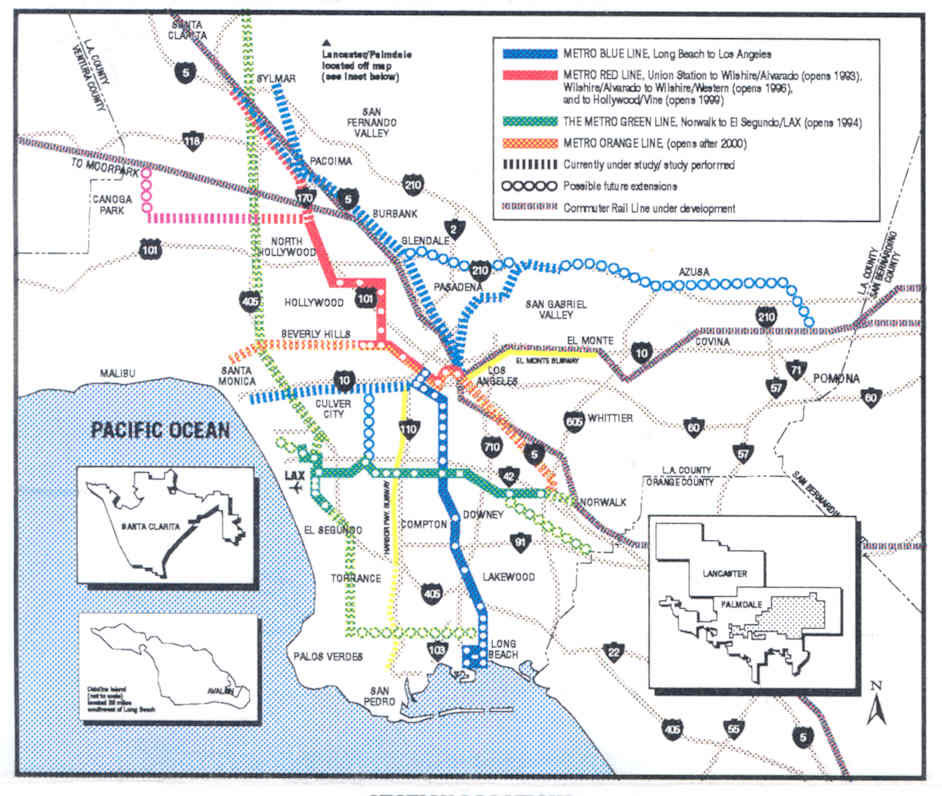
In 1993, the State implemented a merger of the SCRTD and LACTC, to form the current organization, LACMTA, Los Angeles County Metropolitan Transportation Authority. Bits and pieces of a regional transportation grid began to emerge, See map below. (It can be enlarged by opening the link.)

1990 - Long Beach - Los Angeles Metro Blue Line opened.
1993 - Metro Red Line, Segment 1 opened.
1995 - Metro Green Line opened.
1996 - Metro Red Line, Segment 2a opened.
1999 - Metro Red Line, Segment 2b- opened.
2000 - Metro Red Line, Segment 3 - opened
2003 - Metro Gold Line opened.
2005 - Metro Orange Line opened.
2008 - "Bring Back Broadway" initiative with its Streetcar project announced.
2009 - Metro Gold Line Eastside Extension opened.
2011 - Metro Exposition Line, Phase 1, scheduled completion.
2012 - Metro Exposition Line, service to Venice/Robertson station scheduled.
2018 - Metro Regional Connector, (See map below.) scheduled to be completed.
Located Downtown, it will connect the Blue and Expo Lines to the Gold Line and Union Station.
????? - "Subway to the Sea," conditions are not sufficiently clear to predict when trains will be operating to Santa Monica.


  Passengers boarding a Metro Red Line train at Seventh and Figueroa. 

                                                  The Regional Connector.

The Rebirth / Chapter Two

Ostensibly, transportation improvements might appear to be on autopilot; however, this is hardly the case. The economy, local, regional, state and national politics will all have their impact. In 2007, Move LA, an organization dedicated to supporting local transportation initiatives, built a coalition of business, labor and environmental organizations to identify and secure new funds for transportation investments in Los Angeles County. A January 2008, a Move LA conference served as the launching pad for Measure R, a one half cent sales tax that would provide $40 million for transportation projects in Los Angeles County over the next 30 years.  In November 2008, Los Angeles County voters approved Measure R with a 67.22% margin, a hair above the California State requirement of 2/3 support for new taxes. Mayor Antonio Villaraigosa championed this initiative and has emerged to play a leading role in national transportation policies. 

Move LA spearheaded the National Infrastructure Development Bank and its associated 30/10 Plan which could lead to the completion of all Los Angeles' 12 Measure R transit projects in 10 years rather than 30 years. Mayor Villaraigosa and his staff, working with Metro staff, refined the program into a legislative package known as Move LA's 30/10 Plan. Subsequently, this plan was endorsed by Senators Boxer and Feinstein, the LA Metro Board and Richard Trumka, President of AFL-CIO, among others. An innovative funding methodology emerged. Rather than wait for Federal grant monies which might or might not be delivered, Move LA conceived of a plan to obtain credit assistance and tax code incentives which reduced the cost of borrowing and accelerated the delivery of construction funds. 

On June 21, I attended Move LA's all-day conference, "A Bigger Vision: Moving LA Fast Forward." The breadth of participants was staggering: local, state and regional transportation, local, state and regional government, business, labor, environment, housing, bicyclists, and neighborhood leaders. It was clear that everyone shared the same objective: to accelerate the construction of LA's much needed transportation projects as rapidly as possible.

Implementing these mass transit objectives is critical to the future of Los Angeles. As the world continues to become increasingly urbanized, Los Angeles must be remain competitive.


The above diagram indicates world population growth between 1950 and 2005. During this period, the world's population tripled reaching 3.15 billion. Cities in the developing world are growing rapidly. By 2020, 77% of the world's population is expected to live in cities in developed countries. Individual mobility demands can be satisfied most efficiently in urban areas. The Los Angeles expanding transportation system is going to assist this region in coping with the demands of increasing new populations as they arrive.

Getting back to Move LA's all-day conference, LA Metro CEO, Art Leahy, said that the had taken the Gold Line from Pasadena to Union Station and walked up the Temple Street hill to Cathedral Plaza, the site of the conference. I, too, took the Gold Line to Union Station, transfered to the Blue Line and got off at City Hall. Then I walked up Tempe Street hill. As I walked, I did not find any compatriots. I saw a continuous line of cars entering the Cathedral parking garage. At the Move LA conference, I wanted to ask if anyone else had taken public transportation; however, I was afraid to raise the issue for fear of injecting a dissident note because it was apparent that few had.

Then, I saw Green T - Tamara Henry, with her large red STOP sign describing her 1hour and 35 minute bus ride from Venice to Downtown LA,  She made the point much more effectively than I could.

Follow this link to Tamar's detailed report on the June 21, event. Move LA - Moving LA Fast Forward

As the conference ended, I was walking down the stairs with LA Metro CEO, Art Leahy, and told him how much I liked the LA subways because they reminded me of New York. He said, "I hate New York!"

Sunday, May 22, 2011

ART IN THE STREETS / A SEMINAL BLOCKBUSTER

THE GEFFEN CONTEMPORARY AT LA MOCA
April 17 - August 8, 2011


My exhibition experience!

It was great! Visually stimulating! Provocative! Challenging! Vibrant! Joyous! Satisfying! Humorous at times, and often confusing in terms of location and what I was seeing. As I looked around the gallery, I sensed that others were experiencing similar reactions. While moving slowly through the chronology section, I spoke to a young woman who shared my enthusiasm. Later I asked one of the guards for his evaluation of visitors' reactions; he assured me that what I was experiencing reflected the sentiments of the vast majority of the crowd.


Here is a link to photographs of some of the works in the exhibition

From Jeffrey Deitch's introduction to the exhibition catalogue

"Arguably the most influential art movement since Pop, graffiti—as we know it today—was invented by teenagers. The convergence of street art and graffiti styles that emerged from housing projects, subway yards, and bleak suburban parking lots has become a global phenomenon. It continues to thrive and evolve forty years after it began.

"The strongest artistic innovations quickly become international, spreading from one city to another through networks of artists: The wild style graffiti that was born in the Bronx spawned or connected with local styles in cities such as Los Angeles, San Francisco, London, and Sao Paulo. Like other important artistic trends, the graffiti impulse could not be confined to one medium. The emergence of graffiti paralleled the genesis of hip-hop, its artistic vocabulary spilling over into break dancing, street fashion, and the language and rhythms of rap music. In the mid-1970s, the New York subways were like total works of art. Every square foot of the trains' surfaces, inside and out, was bombed with tags and throw-ups. Riders were blasted by the beats coming from boom boxes. A subway trip could be an immersion into utter urban anarchy or a shot of explosive artistic energy—it was probably both.

"Many artistic innovations occur during periods of prosperity and economic expansion. The emergence of graffiti as an art form in the '70s occurred in a time of economic and political challenges: the oil embargo of 1973, the stock market decline, and the malaise over the Vietnam War were among the factors that signaled the end of the American dream. The youth culture and the liberation movements of the late '60s had taught that anyone could be an artist. The unfulfilled promise of '60s idealism clashing with the disappointing reality of America in the mid-'70s led to angry and anti-authoritarian art forms such as graffiti and punk rock."

My discovery of graffiti


For me, it began with "Taki 183," the omnipresent signature that you found all over New York in the 70s on buildings, the subway, doorways, lamposts and wherever you looked. This was only the tip of the iceberg. Soon graffiti had conquered the entire subway system, inside and out. I knew only New York graffiti even though it was appearing in many other places.


The New York graffiti artists of this time were spray paint gymnasts. The animated manequins seen in the exhibition are convincing replicas of the real thing. The wall of spray paint cans in the exhibition demonstrates their tool kit.


What qualifies ART IN THE STREETS as a seminal / blockbuster exhibition?

As Peter Deitch said above, graffiti is "Arguably the most influential art movement since Pop." I have been aware of bits and pieces of this phenomenon over the last forty years. Roaming through the streets of SOHO, in the 1970s, one was constantly confronted with the graffiti movement as it was emerging. I was witnessing graffiti everywhere, but never put the pieces together. Previously, I saw it as a series of isolated phenomena. It took ART IN THE STREETS to awaken me to the vibrancy, vitality and majesty of this incredibly vigorous art movement.

This is exactly what a seminal exhibition accomplishes. It creates an awareness that did not exist previously for you. I am going to assume that most of the people whosee this exhibition will experience a similar awakening. For that, I thank and congratulate Peter Deitch and his collaborators.

As a new LA resident, thanks to ART IN THE STREETS, I see graffiti wherever it exists here in a new light. It confronts me in the part of the city in which I live, Boyle Heights, and the part of the city in which I spend most of my time, Downtown Los Angeles. There is graffiti in other parts of LA which are beyond the range of my routine travels.

Check out this excellent site - The Dirt Floor

By way of explanation / seminal exhibitions:

A seminal exhibition offers fresh, insightful and compelling cultural and intellectual content. It demands that you re-evaluate your established ideas. Beyond that, it offers new concepts which might not have entered your mind. Sometimes these concepts have been tested, sometimes not.

By way of explanation / blockbuster exhibitions:

Blockbuster art exhibitions are ubiquitous - a dime a dozen. Some are of real quality; some are atrocious hoaxes. Generally, they are lavish displays of famous and not-so-famous works of art that are seldom seen or are presented in a new context which might make them appear to be more unique and/or special. Some might be spectacular to see; some might have intellectual content, most do not. The term "blockbuster art exhibition" joined our lexicon when Tom Hoving, the brilliant and imaginative director of The Metropolitan Museum of Art, brought the The Treasures of Tutankhamun to this country in the 1970's.

Distinguishing between seminal and blockbuster exhibitions

Below are examples of both, most of which I have seen over a number of years.

Seminal

Cubism and Abstract Art and Fantastic Art Dada and Surrealism were the two most seminal exhibitions ever presented in an American art museum. Alfred H. Barr, Jr., founding director of The Museum of Modern Art in New York, was curator of both. In 1936, they established the canons of interpretation for the historical roots of the modern art movement. Often embellished and revised, the content of these two exhibitions has influences how most Americans view the Western European roots of the modern art movement. At the time, these two exhibitions appealed to a small coterie of wealthy modern art cognoscenti.

http://www.moma.org/learn/resources/archives/archives_highlights_02_1936 

Blockbuster

The Family of Man,a huge photographic exhibition in 1955 at The Museum of Modern Art in New York, had lines of people stretching from the museum entrance in the middle of the block on West 53rd Street to Fifth Avenue. Essentially a composite of the personal choices of Edward Steichen, Director of the Department of Photography at MOMA, it was an idiosyncratic exhibition that elevated photography to a new level. The design of the exhibition was a maze; it compelled gallery goers to investigate its nooks and crannies. This was one of the first times that photo blow-ups appeared in an art museum.

http://en.wikipedia.org/wiki/The_Family_of_Man

Seminal / Blockbuster

In the late 1970s, the new Centre Georges Pompidou in Paris emerged as a fountainhead of 20th century art interpretation. Paris-New York, Paris-Berlin and Pairs-Moscou, a trilogy of exhibitions organized by Pontus Hulten, examined 20th century art history through links between these art capitals. These exhibitions included art objects, films, posters, documentation, and reconstructions of exhibition spaces such as Gertrude Stein's salon. Pontus Hulten was the founding director of LA MOCA. Arriving in 1980, he left in 1984.

http://en.wikipedia.org/wiki/Pontus_Hult%C3%A9n

Blockbuster

The Treasures of Tutankhamun, jointly organized by The Metropolitan Museum of Art and National Gallery of Art, Washington, the exhibition opened in Washington in 1972 and later went to The Metropolitan Museum in New York. It toured American cities until 1981 and attracted, at that time, unprecedented crowds. To accommodate huge number of visitors, a reservation system was developed  with tickets being sold on specific dates for specific time slots.

http://en.wikipedia.org/wiki/Exhibitions_of_artifacts_from_the_tomb_of_Tutankhamun

Seminal / Blockbuster

In 1986, the Centre Pompidou presented Vienne 1900-1938, l'apocalypse joyeuse, another exhibition which defined the totality of a city as an art center within a specific period of time. It embraced art, cultural history, political history and the impact of Nazism on the Jewish artists and intellectuals who made Vienna their home. Clearly a seminal exhibition, it was immensely popular. The Centre Pompidou initiated evening openings with a midnight closing.

http://www.centrepompidou.fr/pompidou/Communication.nsf/0/88D31BDB4FE7AB60C1256D970053FA6

Borderline Seminal / Blockbuster

Circa 1492: Art in the Age of Exploration, National Gallery of Art, Washington, 1992. This remarkable exhibition depicted the global society of the late 15th century. Although studded with masterpieces, it made a significant cultural statement demonstrating the diversity, vitality and interconnectedness at that time of the world's population and cultures. Perhaps more blockbuster than seminal, its intellectual content cannot be overlooked.

http://www.nga.gov/past/data/exh640.shtm

Blockbuster

Aurea Roma: DallaCittàPagana alla Città Christiana (Golden Rome: From the Pagan City to the Christian City) 2000, Palazzo delle Esposizioni, Roma. This exhibition was planned to coincide with the celebration of the 2,000th anniversary of Christianity. Although it confirmed the power and opulence of the Catholic Church, it also presented a non-theological view of the emergence of a monotheist society.

http://www.palazzoesposizioni.it/Mediacenter/FE/CategoriaMedia.aspx?idc=288&explicit=SI

By way of explanation / my seminal / blockbuster exhibitions:

Having created two exhibitions which were seminal / blockbusters, I can speak with some authority.


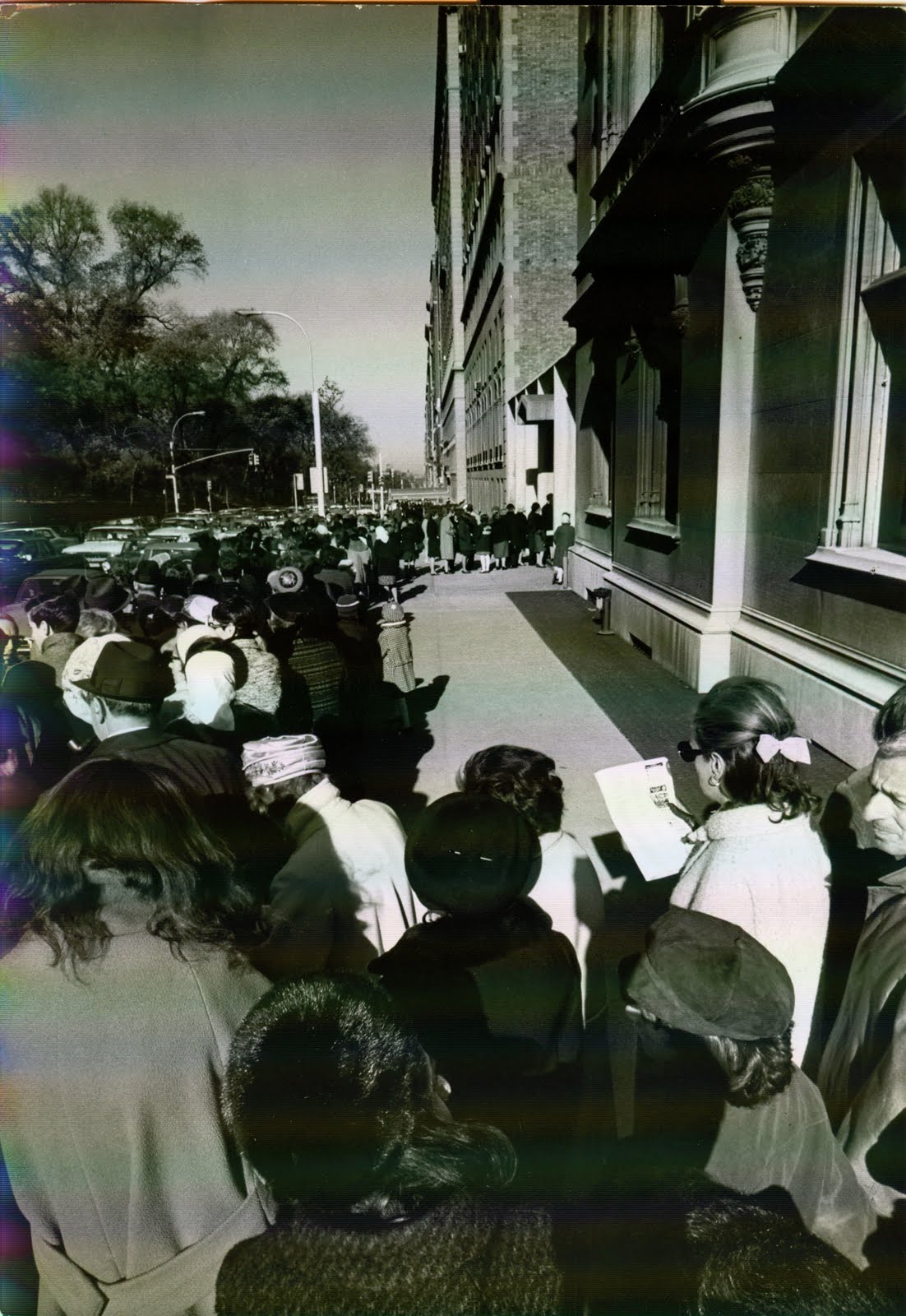
Above: Photo of crowds waiting to enter The Lower East Side: Portal to American Life exhibition at The Jewish Museum, 1966. There were lines from Fifth Avenue to Madison Avenue along 92nd Street.

In 1966, I created The Lower East Side: Portal to American Life exhibition at The Jewish Museum in New York. It is listed among thousands of other events in world Jewish history in The Timetables of Jewish History: A Chronology of the Most Important People and Events in Jewish History. This exhibition invigorated a sense of ethnic pride among Eastern European Jewish immigrants and their progeny; it encouraged other ethnic groups to follow a similar pattern.


Above: Photo of crowds in the 1940-1949 section of the Harlem On My Mind exhibition at The Metropolitan Museum of Art.

In 1969, I createdHarlem On My Mind: Cultural Capital of Black America: 1900 - 1968, an exhibition at The Metropolitan Museum of Art. In Displays of Power: Memories and Amnesia in the American Museum author Steven C. Dubin wrote: "Harlem On My Mind is a landmark. It opened the doors of cultural institutions to multimedia. It helped define the blockbuster exhibition." Of the exhibition catalogue which reflected the content of the exhibition, Henry Louis Gates, Jr., chair of the Afro-American Studies Department at Harvard University, said, "This catalogue ...remains ... one of the richest and most comprehensive records of the African-American in the twentieth century."

The exhibition was divided into six chronological sections: 1900-1919 / From White to Black Harlem, 1920-1929 / An Urban Black Culture, 1930-1939 / Depression and Hard Times, 1940-1949 / War, Hope and Opportunity, 1950-1959 / Frustration and Ambivalence, 1960-1968 / Militancy and Identity.

Conclusions

ART IN THE STREETS annointed graffiti with new status. What does all of this portend for the contemporary art world? Will there be a graffiti reevaluation in the global art market where art is sold like commodities on the stock market? Will graffiti enter the global art market as a new and desirable art commodity?

Most people who call themselves artists today want to see their work exhibited in museums. They view inclusion in a museum show as a careerism stepping stone. Graffiti is outsider art; it's original intent had nothing to with museums and their associated prestige.

There is no question that this exhibition has set in motion a whole new set of options. Perhaps we will begin to see plaques placed alongside graffiti works with the names of collectors who have purchased them from artists or their agents? Perhaps we will see evanescent graffiti works on video sold much as Bill Viola markets his art? Perhaps none of these will happen? Perhaps the movement will fade into oblivion? (I hope not.) We'll just have to wait and see how all of this plays out!

Graffiti is created to be seen in situ.(Some graffiti artists were commissioned to create specific works seen in the exhibition galleries.)From my perspective, rather than transforming non-museum art into displayable museum art, there might have been another approach. I would like to have seen a battery of webcams attached to video projectors presenting varied examples of graffiti so that they would have been seen in context - on the streets. For me, this would have been a more authentic presentation of current examples. With regard to presenting historical examples as museum objects, I concur with doing this by way of interpretation. That's a different story.

ART IN THE STREETS
is a must see exhibition.It is big and diverse, not the kind of exhibition that one can digest immediately. I have seen it twice and am going again next week.

Saturday, May 14, 2011

Last Remaining Seats

King Kong - The Eighth Wonder of the World


King Kong, 1933

As a member of the Program Sub-Committee of the Los Angeles Conservancy's Last Remaining Seats Committee, I prepared the program notes for King Kong. Having seen it first as a child and many times again as an adult, for me, it demonstrates the wonders of movies - the ability to create a total unreality. It will be shown at the Los Angeles Theater on June 15.

http://www.laconservancy.org/remaining/2011.php4

http://www.losangelestheatre.com/

Special guest at this showing will be Pauline Wagner (who is 100 years old). She was Fay Wray's stunt double in the film. Below is a recent interview with Pauline Wagner, as well as some scenes from King Kong.

http://www.youtube.com/watch?v=0iM1uKG0ZhI

http://www.youtube.com/watch?v=H0WpKl2A_2k

My Program Notes

Ray Bradbury called it one of the “greatest films ever made” Andrew Sarris disdainfully dismissed it as a “B” picture. There is no question that King Kong, can be viewed as an iconic masterpiece of special effects filmmaking. It has been remade, imitated, and bastardized while at the same time generating a genre that has flourished ever since its release. Peter Jackson, director of The Lord of the Rings said, “Watching that film propelled me into a love of making movies and learning how to do visual effects, the very stuff of movie magic.”

The creative force behind the film was Merian C. Cooper - adventurer, explorer, filmmaker, journalist, prisoner of war, studio executive, technical innovator and war hero all rolled into one. Leading man, Carl Denham, could be seen as a personification of Cooper.

Prior to making King Kong, Cooper had traveled to the South Seas and Africa aboard The Wisdom as a member of Captain Edward A. Salisbury’s expedition. Its purpose was to create documentary films and written records of their explorations. Ernest Shodesack, who later became Cooper’s collaborator and co-producer, joined The Wisdom expedition in Sumatra. Cooper and Schodsack later made documentary films in Siam (Thailand). They released two: Grass (1925) and Chang (1927).

Cooper and Schodesack came to the making of King Kong with considerable experience in exotic cultures. They amalgamated that with the wizardry of Willis O’Brien’ s technical effects.. The script is pedestrian good guy / bad guy with beauty and the beast throw in for good measure and love triumphing as the last scene fades out. What sets King Kong apart from all others is O’Brien’s special effects. O’Brien had pioneered the art of three-dimensional stop-motion animation for nearly twenty years. In reality, King Kong was not 18 feet tall weighing a ton. He was an 18-inch metal armature with articulated joints enveloped with cotton and string, coated with latex rubber and covered with rabbit fur. In order to achieve a sense of motion, the figures had to be manipulated and photographed frame-by-frame (24 frames per second, 1,440 per minute). Miniature jungle environments served as backgrounds and foregrounds for three-dimensional illusions including rear screen projections.

The derisive ethnic stereotyping common in motion pictures and accepted across the board in American society during the 1930s is viewed today as offensive. We see the tribal chief as an aboriginal caricature and the Chinese cook, Charlie, as a strange backward foreigner.

The film did not receive any Academy Award nominations. In 1975, it was named one of the 50 best American films by the American Film Institute. In 1991, King Kong was considered to be "culturally, historically and aesthetically significant" by the Library of Congress and selected for preservation in the United States National Film Registry. In 1998, the American Film Institute ranked it as number 43 on its list of the 100 greatest movies of all time.
______________________________________________________________________
As is the Hollywood practice, film classics are regurgitated time and again. Being a purist, I have never seen them.


l976 - Produced by Dino de Laurentis

King Kong (1976)


2005 - Directed by Peter Jackson 

King Kong (2005)

Friday, March 4, 2011

Food Merchandsing in America / Chapter One

Food Merchandising: From Art to Spectacle, Chapter One - It All Began With Dean & Deluca on Prince Street in SoHo

In September 1977, when Joel Dean, Giorgio Deluca and Jack Ceglio opened their first food store on Prince Street in SoHo they set in motion a food revolution that encompassed merchandising, taste and style transforming the way that Americans sold and bought food. At that time, SoHo was the locus of the avant-garde art world in America.  A sizable colony of artists were transforming the surrounding commercial and industrial buildings, some dating back to the Civil War era, into loft living spaces. The works that SoHo artists created remain significant in 20th century art history. These artists were the Dean & Deluca clientele, so it was logical that their neighborhood food store should itself become a work of art.
For a brief period of time, SoHo served as a significant style generator in art, food, clothing and life style. In fact, SoHo became a symbol of what was new and hip. It became so commercial that Bloomingdale's opened a store on Broadway between Prince and Broome.


As I remember it, the Dean & Deluca Prince Street store was about forty feet wide and one hundred and twenty feet deep. Like the nearby galleries, it was a pristine white environment accentuated by stainless steel and glass refrigerated display cases and free-standing metal shelves. As you entered the door, you were greeted by a sculptural display of fruits and vegetables with operatic arias wafting above your head. The employees, young and attractive, were outfitted in pristine white uniforms. They were knowledgeable and passionate about the food  they were selling. The breads, cheeses, olives and prepared meats looked spectacular and their taste was superb. It was a memorable aesthetic experience to enter this space and purchase food.


In 1985, I spent a weekend at Dean & Deluca providing samples of my wife Mary's Grafton Goodjams made in small batches of organically grown fruit and Vermont maple syrup. Based on this experience, I was aware of a transformed clientele. There were more women in pastel clothing than jeans. The pastels were the "bridge and tunnel crowd" from New Jersey and Long Island, as they were disdainfully described by by SoHo residents. It was these suburbanites who expanded the Dean & Deluca audience beyond SoHo.

In 1988, outside investors entered the picture and bank rolled expansion with a move to the corner of Prince and Broadway.


This was more a football field-sized space. Joel Dean and Giorgio Deluca moved their offices from the back of the Prince Street store to the back of the Broadway store. From there, they could maintain a watchful eye on every detail of the store's operation. Both were often seen roaming the aisles to be certain that their standards were maintained. Even though expansion had taken place, there was no diminution of quality.


When Giorgio Deluca saw my wife Mary's Grafton Goodjam vinegars, he ordered some and placed them prominently in the store. Exposure at Dean & Deluca served as a catalyst to expand her market nationwide.

Typical of investors, they wanted to see expansion. Stores were opened in Georgetown, Maryland; Charlotte, North Carolina and St. Helena, Napa Valley, California. Added to the mix were a number of Dean & Deluca Coffees like this one illustrated below on the ground floor of Renzo Piano's New York Times building.


Fortunately, through the years with a number of different owners and the departure of Giorgio Deluca (who now has his own  restaurant in SoHo) and Joel Dean (who unfortunately died several years ago), the same level of quality has been maintained. Below is a photograph that I took recently at the Prince and Broadway store.

Fortunately for those of us who appreciate this store, the passion and sensitivity for good food that Giorgio Deluca and Joel Dean exuded remains in tact. I have never been disappointed by any purchase that

I made at a Dean & Deluca store over more than thirty years.


From its SoHo art world origins, the Dean & Deluca style has gone mainstream. As one travels around country, you see formulaic imitations, none as good, but these stores offer an enhanced food merchandising experience contributing to the lives of many of us. Whole Foods is probably the most evident example. Every major supermarket chain has its imitation of the Dean & Deluca model. Many of these beneficiaries of enhanced food merchandising might never have heard of Dean & Deluca.

Is the artful presentation of food still a valid style? My answer is yes, but ... there are new winds circulating - Eataly in New York in particular. Eataly will be examined in the next post.