Thursday, February 23, 2012

Why I Voted for "The Artist" as Best Picture

I have seen it three times:
January 16, 2012, 4:00pm
Landmark Theater
10580 West Pico Blvd. 
Los Angeles, 90064
January 30, 2012, 7:30pm
TV Academy
 5230 Lankershim Blvd.
North Hollywood, 91601
A screening followed by a question and answer with writer/director Michel
Hazanavicius, star Jean Dujardin, actor James Cromwell, costume designer
Mark Bridges, and production designer Laurence Bennett. 
February 7, 2012, 7:30pm
Directors Guild Theater, #1
7920 W. Sunset Blvd.
Los Angeles, 90046
A screening followed by a question and answer with executive producer Richard
Middleton, executive producer Antoine De Cazotte, director of photography
Guillaume Schiffman, costume designer Mark Bridges and production designer
Laurence Bennett. 

"A Masterpiece" 

At the Directors Guild Theater, as I scrambled to permit a dowdy sixty year-old 
woman sitting next to me make her way to the bathroom, she murmured, "As a
member of the Academy, I see two hundred pictures a year." She returned and
we sat in silence throughout viewing "The Artist." When it ended, spontaneously
she exclaimed "A masterpiece." I buy that!

Is "The Artist" a French film or a Hollywood film?  
Because it was made in Hollywood, it qualifies as an American made film
and can be considered for Oscars; however, it clearly demonstrates French
style and sensibility. Film credits abound with American names, but no American
director could have conceived of making a silent film today. When asked why
he chose to make a silent film, writer/director Michel Hazanavicius said that
it was the logical way deal with the film's themes: the end of the silent film
era, the birth of sound movies and the consequences that ensued. Asked if
he would make another silent film, Michel Hazanavicius' reply was emphatically
negative. "The Artist" is not a tour de force nor a gimmick. Hazanavicius sought
to evoke nostalgia during a moment of crucial transition in the history of motion
pictures. Thus, a silent film in aHollywood setting.

Rather than a blunt exposition, he chose to create a credible fantasy in which
we are witness to the vicissitudes of stardom, an often told tale.  Hazanavicius
is a product of the French school of "auteur" filmmaking in which a director
is granted license (generally within the bounds of commercial viability) to
express oneself.

So what do I know about Hollywood films?  
In the 50s and 60s, I managed to have contact with some of the great directors
of that period: Vincent Minnelli, Rouben Mamoullian, George Stevens and Fred
Zinnemann.

Vincent Minnelli got Best Picture for "An American in Paris," in 1951
http://www.youtube.com/watch?v=FiiaJRXPAm4
and " Gigi" in 1958.
http://www.youtube.com/watch?v=jEofRODHZ1w

George Stevens got Best Director for "A Place in Sun," in 1952
http://www.youtube.com/watch?v=wEuFNnJSIw8
and Best Director for "Giant" in 1956.
http://www.youtube.com/watch?v=w2x6AT4mr3o

Fred Zinnemann got Best Director
for "From Here to Eternity" in 1953
http://www.youtube.com/watch?v=_reftTX0Ayg

These films were grand epics, solidly produced and refined in detail. The casts
provided outstanding performances. These films continue to resonate for me as
demonstrations of some of the best that Hollywood has to offer. There is no
question that episodic changes in style occur in every creative medium. Perhaps
my taste in films is stuck in the 50s and 60s, or perhaps films of this era
demonstrate a cohesion seldom found today?

Filmmaking aside, I had a modest impact in Hollywood at this time. Returning
from a trip to Italy with a home espresso maker, I told Rouben Mamoulian's wife
about it. She wanted one. I sent one to her and can make the dubious claim that I
introduced the first home espresso maker to Hollywood.

What do I know about French films? 
I am a fan of Godard and am familiar with the films of the other directors of
Nouvelle Vague fame. Over the last forty years, I have probably seen twice as
many French and Italian films than American films. Rather than knowledge
of films, my expertise regarding France stems more from everyday experience.
While in graduate school, I would hang out in Paris, sitting in Deux Magots
on the Boulevard St. Germain with a Galoise dangling from my lip, waiting
for Sartre or Simone de Beauvoir to appear. Over the years, I got to know Paris
well enough to lead a group of New York architects, planners and city officials
around examining Paris as an evolving global city. I even wrote an article in
French that appeared in Libération.

What do I know about French sensibility as it applied to "The Artist?" 
This has to be a personal and subjective judgement, but I am willing to take a
shot at it. I see "The Artist," not in universal terms, but as a manifestation of
French style in its ability to elevate the mundane to more "heroic" terms.
Perhaps this might explain the enduring universal appeal of Antoine de St.
Exupéry's novella The Little Prince. For me, "The Artist" resonates a similar
appeal; however, its appeal is not in fantasy. Rather than fantasy, its appeal
can be seen as a parable (success is ephemeral) for everyone.


Art Versus Commerce / Commerce Versus Art 
When the Weinstein Company enters the picture, the fine line between art
and commerce frays; however, that is not to say that is necessarily bad.
The flood of newspaper ads, the multiple screenings, the tv appearances,
and YouTube trailer all contribute to selling "the product."

My Oscar predictions
It is an irresistible masterpiece. It is going to get Best Picture and Best
Director (Michel Hazanavicius), Best Leading Actor (Jean Dujardin),
and possibly more.

Footnote
I am not a member of The Academy nor any of the guilds. However, I fit
the LA Times' recently published demographic for Academy members. I
am Caucasian and over sixty.


Saturday, December 3, 2011

My Take on How Los Angeles Invented the World


On November 19,  2011, a program entitled "How Los Angeles Invented the World," was presented at The Getty Center as an event associated with Pacific Standard Time: Art in LA. 1945-1980.
http://www.pacificstandardtime.org/
A shuffled replay of this event can be s
een: 
http://zocalopublicsquare.org/thepublicsquare/2011/11/20/was-ever-a-city-more-bewildering/read/the-takeaway/

 In a previous blog post, I criticized the organizers of "How Los Angeles Invented the World" for presenting a program without significant content that veered toward boosterism.


So, here's my take. There is no question that Los Angeles has and continues to make contributions to our global society in two principle areas: the entertainment industry and the space program.  Being more familiar with cultural history, I will begin with the entertainment industry.

LA Invented the Academy Awards


In 2010, approximately 41,300,000 people watched the Academy Awards in the 
United States.  One night, once a year, lasting 3.5 hours, the eyes and ears of  the
world  are focused on Los Angeles. There is no other place on earth commanding
that kind of attention on an annual basis.  It is in the arena of mass communication
culture that LA has invented a new world. So, what are the Oscar attractions? It 
offers mesmerizing presentations of fashion, glamour, fame and celebrity. Did LA 
invent fashion,  glamour, fame and celebrity? No, they have been around for a long
time; however, LA has turned them into global mass market commodities.

Suggested panelist: Dawn Hudson, CEO, The Academy of Motion Picture of Arts and Sciences.

Fashion, glamour, fame and celebrity in Ancient Rome 
Ancient Rome was awash with all of these personal attributes. The most famous person of this era and its most enduring celebrity was Cleopatra, a Hellenistic Egyptian woman of noble heritage whose life was entwined with, among others, two Roman leaders: Julius Caesar and Marc Antony. In their Preface to the 2001 catalogue of The British Museum exhibition, "Cleopatra of Egypt," Susan Walker and Peter Higgs ask, "Who's my Cleopatra?',  for it is abundantly clear that there are many Cleopatras (an ambivalence encouraged in her lifetime by the queen) ..." For the less historically minded and more Hollywood influenced, the answer to "Who's my Cleopatra?" would be Elizabeth Taylor.

Top image: Cleopatra, bronze 80 drachma coin, Alexandria, 51-30 BCE.  Below: Elizabeth Taylor as Cleopatra, 1963.


Suggested panelist: a curator from the Getty Villa.

The Movies Come to Hollywood


Cecil B. DeMille on the running board with some of the actors in his movie, The Squaw Man, 1914.  DeMille left New York with cast and crew prepared to make the film in Flagstaff, Arizona.  When they arrived, they found the scenery unsuitable, so they headed for Hollywood, thus accelerating the development of the motion picture industry.


In the 19th century, traditional culture, theatre and symphony performances, found
an audience in the educated upper class and arriviste bourgeoisie. With the emergence
of an industrial consumer society in the late 19th century, the birth of  the urban
working class heralded a new social phenomenon; there were no precedents providing
entertainments for this expanding population. Vaudeville and its companion, burlesque,
first seen in store front theatres, emerged as low-priced forms of entertainment accesible
to all classes. Vaudeville theatres catered to the broad masses as well as to audiences of
traditional theatres and concert halls. Penny arcades and nickelodeons, where primitive
motion pictures were shown, catered to similar audiences. All four, served as incubators
for the motion picture industry which initiated the era of industrialized entertainments.
As a footnote, throughout the 1930s, films, as attractions, did not stand on their own;
vaudeville acts served as an introduction to film showings.

Suggested panelist: David Nasaw,  Arthur M. Schlesinger, Jr. Professor of History,
The Graduate Center, City University of New York, author of  Going Out: The Rise and
Fall of Public Entertainments.


The Creation of Celebrity Culture


                                  Clark Gable and Vivien Leigh, Gone With The Wind, 1939. 


Celebrity, as we know it today, is a product of our consumer oriented industrial society. Each new technology has made its contribution: telegraph, telephone, motion pictures, recorded sound, radio, television and the internet. As new forms of entertainment have evolved, they have spawned an army of supporting promotional entities: agents, publicists, columnists and fan publications serving intoxicated public appetite for identification with fame.


                                    The Walk of Fame, Hollywood Boulevard, Los Angeles, 2011. 


 A Hollywood product, Desi Arnaz and Lucille Ball in their highly successful sitcom television series,  "I Love Lucy," 1955. At the time, it was one of the most watched tv shows in America. Reruns are still seen by 40 million Americans each year.


 Michael Jackson personified, the ultimate "pop music star."  This album was issued in 2008 on the  occasion of this 50th birthday. It was released in 26 countries.


American Idol: The Search for a Superstar, is currently the most-watched show on American television. It began in 2002.  As an adaptation of a British tv program, it did not originate in Los Angeles; however, it was identified with Los Angeles in its infancy. 

Suggested panelist: Maureen Orth, author, critic and Vanity Fair columnist.  In her book, The Importance of Being Famous,  she talks about "The DNA of Fame," and "The Celebrity - Industrial
Complex."


Space Technology 


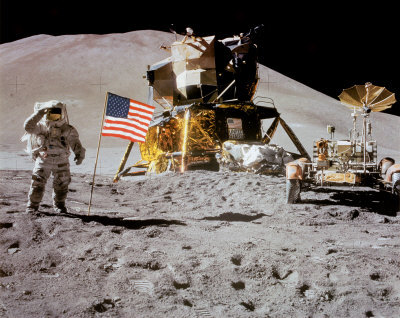
                                   Landing on the Moon, 1969 


The Jet Propulsion Laboratory (JPL), headquartered in Pasadena, is managed by the California Institute of Technology for NASA. The Jet Propulsion Laboratory was the birthplace of the American space program and plays a prominent role in its continuation.  http://www.jpl.nasa.gov/
The Laboratory's primary function is the construction and operation of robotic planetary spacecraft, though it also conducts Earth-orbit and astronomy missions. Among the Laboratory's current projects are a mission to Saturn and the Mars Reconnaissance Orbiter. 

Suggested moderator: : K. Anthony Appiah, is currently the Laurance S. Rockefeller University Professor of Philosophy at Princeton University. He is a philosopher,  cultural theorist and novelist. 

CONCLUSION: I believe that above panel addresses the issue of  "How LA 
Invented the World," and would provide the audience with some thoughts 
worth considering and discussing further. It is not planned as an entertainment, 
rather as encouraging intellectual speculation.


Thursday, December 1, 2011

Occupy LA Rebounds Mightily


I just returned from the post-police raid Occupy LA General
Assembly which convened, with permission from the mayor,
at 7:30pm on the west steps of City Hall. Approximately 200
people sat on the steps in clusters of ten, forming some 20
affinity groups with the same agenda: "what do we do next?"

When it came time for reports from each group, there was
no rehashing the events of the previous day. Every person
who spoke was clear, focused and articulate. They accepted
dismantling the City Hall encampment as signaling the need
to move forward in different directions. One common theme
emerged from virtually every report - the need to decentralize
and reach out to neighborhoods across LA taking the "we are
the 99%" message to as many people as possible.

Because some familiar faces were missing, there must have
been a previous decision for certain people to get arrested
while others did not in order to have a core group who could
maintain momentum. Apparently, the need for horizontal
decision-making must have been  abandoned temporarily.

I left this meeting more hopeful than ever before recognizing
that the Occupy LA movement is not only resilient, it is dynamic.

Wednesday, November 30, 2011

LAPD Removes Occupy LA from City Hall Park


Above: Sunday evening, November 28, three thousand people 
gather in support of Occupy LA at its site in City Hall Park. Not
visible, I am seated on the ground behind the woman in the rose
colored sweater in the center left. Below: In the wake of the LAPD
raid the night before, on Wednesday morning, November 30, a 
sanitation worker is clearing the steps in front of City Hall. 


What Occupy LA Meant to Me
I am chagrined to see it disappear - hopefully momentarily. For
me, it represented a breath of fresh air in our society which has
been overwhelmed by greed and indifference. Occupy LA was
one of many such encampments around the globe inspired by
Occupy Wall Street in Lower Manhattan. The movement's slogan,
"We are the 99%," resonated and needed no explanation. For
everyone, there was no question of "which side you are on."
Those of us who would welcome social change were inspired;
those who want to see the imbalance continue were threatened.
Social revolutions are long term affairs: evolving, contracting
and finally blossoming.

There is no question in my mind that we are seeing only the
beginning of the Occupy movement that might morph into
something more enduring. Although the Occupy movements
disdain vertical leadership, there is a cadre of people called
"point persons," who have emerged with knowledge and
experience; hopefully, they will not disappear, nor will they be
co-opted by the system that they abhor. Organized labor, which
has been marginalized, sees a potential for itself in aligning
with the Occupy movements. Hopefully, together they will be
able to sustain the momentum that has evolved to date. However,
I fear that the repressive apparatus of the FBI and Homeland
Security clearly wants to extinguish any vestige of the occupy
movement. Hopefully, they will not succeed. I sense that we are
moving into a period of dramatic and exciting social change which
will influence the lives of generations to come.

While it lasted, Occupy LA was an integral part of my life and
consequently, my wife, Mary's life. (Below, Mary is not sleeping; 
she is relaxed in reverie.)


For us, Occupy LA symbolized the idealism of the hippie movement
of the 60s and 70s which was so identified with our lives.


Adopting a logo design by Tracy Fink, I was able to get
American Apparel to provide us with 200 printed tee
shirts. They disappeared in five minutes.

Tuesday, November 22, 2011

How Los Angeles Invented the World

January 19,  2011 at The Getty Center
A program of Pacific Standard Time: Art in LA. 1945-1980
http://www.pacificstandardtime.org/

A shuffled replay of this event can be seen: http://zocalopublicsquare.org/thepublicsquare/2011/11/20/was-ever-a-city-more-bewildering/read/the-takeaway/


Panel One - How Los Angeles Created the Good Life


There were three panelists and a moderator - dull / pedantic academics who,
except for one, the curator of photographs at The Huntington Library, exhibited
the enthusiasm of dead fish. The Huntington curator was allowed to show two
photos similar to the one below which demonstrated the innovative Southern
California indoor/outdoor informal life style of the post World War II period
which has since been adapted across America.

Of the three panel discussions, this is the only one which addressed the theme:
"How Los Angeles Invented the World."


Had The Huntington photo curator been allowed to play two minutes of  The
Mammas and the Papas "California Dreamin" as an accompaniment to her slides -

" all the leaves are brown
  And the sky is grey
  I went for a walk 
  On a winter's day 
  I'd be safe and warm 
  If i was in l.a. 
  California dreamin' 
  On such a winter's day" 

there would have been no need for anyone to say another word. The audience
would have been spared thirty minutes of boredom.

Unfortunately, no one mentioned another Pacific Standard Time event, an
excellent exhibition at the Los Angeles County Museum of Art,  "California
Design, 1930-1965: Living in a Modern Way," which documents in well-
organized detail the work of the artists and designers who contributed to this
new vision.
http://www.lacma.org/art/exhibition/californiadesign

Granted that LA today is one of the most ethnically diverse cities in the world,
it was hard to figure out why ethnicity entered the picture. East coast cities like
New York and Philadelphia, plus midwestern Chicago, had long ago established
America's urban multiculturalism with its concomitant ability to accomodate
minority cultures. It took a question from the audience to draw attention to the
long burning issue of restrictive housing codes that were endemic in pre-World
War II LA neighborhoods - with the exception of Boyle Heights which embraced
a highly diverse population of immigrants including Jews, Japanese and Mexicans.

At the conclusion of this session, I don't think that anyone in the audience had
learned a thing about "How Los Angeles Created the Good Life" that he/she did
not already know.

Panel Two - How Life Imitated Art


Because of all the local boosterism, I thought that I had been parachuted into a
luncheon of the Indianapolis Chamber of Commerce; however, I loved every minute
of this one.  It was loaded with an incredible group of extremely talented people
who live and work in LA. For them, LA serves as an ideal background for films,
which is their business. They were: director William Friedkin, critic Richard Schickel,
critic Kenneth Turan, and writer/director Thom Andersen. Reed Johnson of the
Los Angeles Times was moderator.  They considered the inherent instability of the
environment to be one of LA's challenging attributes. Although they alluded to an
LA sensibility, they did not define it. They contrasted the LA image of optimism
with the LA noir image, which they considered equally valid. For them, "Blade
Runner" was an iconic LA film.

Had they addressed the announced theme, "How Los Angeles Invented the World,"
they might have expanded on their contention that Hollywood is the world capital of
film. Had they addressed the announced theme, they might have brought attention to
celebrity culture, the chief product manufactured in LA. There were allusions to
television and cable, but no mention of tv commercials, a local product that influences
more attitudes than movies. Had they addressed the announced theme, they might have
alluded to the space program which was born in Pasadena, a part of Greater LA.

Panel Three - The Past and the Future of LA's Global Image


Another luncheon at the Indianpolis Chamber of Commerce with a panel of brilliant,
creative people. Warren Olney of KCRW was moderator. Panelists were: director
Wim Wenders, director John Singelton, essayist Richard Rodriguez and architect
Eric Owen Moss. How can you not love and enjoy a gab fest with such people? I
don't think that they addressed the announced themes any more so than the previous
panelists, and I don't think that I retain any great ideas expounded here, but, again,
I loved every minute of it.

My conclusions 
It is not easy to run a panel discussion with a bunch of high-powered independent
people; however, there are some methodologies that are often used to keep panelists
focused on the themes to be discussed. I had a good time, but I would have learned
more, which is the reason that I went, if there had been some thematic discipline
evident. It was great entertainment, but not a lot of learning!


This event reinforced New York intellectuals' perception of LA as a place where
entertainment predominates and substance is slight. Overall, I would say that the
organizers of this event blew it. They failed to make a case that LA is beyond fluff.


Sunday, October 16, 2011

LA Trumps New York Big Time!


While Mayor Bloomberg and Brookfield Properties joust in feeble attempts to preserve
their tattered images at the expense of the Occupy Wall Street demonstrators in
Downtown Manhattan's Zuccotti Park, there is a different story playing out in LA. In
sharp contrast, LA's mayor, Antonio Villaraigosa, personally passed out ponchos to the
demonstrators encamped on the grounds of City Hall when it rained. The LA City
Council voted in support of the encampment. The police cooperate because they have
identified their collective bargaining rights with issues raised by the protesters.


Around 5:00pm on Thursday, October 13,  I made my first visit to the
Occupy LA site. Straying from the sidewalk into a cluster of tents, I
introduced myself to a young man sitting by himself in one of three
folding canvas chairs embracing a small propane stove. Asking if I
could join him, he welcomed me introducing himself as Stiles. I
thought that he might be African American; however, he hails from
South São Paolo, Brazil. He said that he was now 21, had entered
college at the age of fourteen and received an M.A. degree before he
was 20. He described his occupation as a "street fighter," a person who
fights with his fists and knives while others bet on the combattants. It
appeared that Stiles had been in LA before and spoke unaccented English
because his father is an American.

While we were talking, I got a call on my cell phone. It was someone calling
to request money for the Yale Graduate School Alumni Fund. In the past, I
had given the munificent sum of $50. I agreed to repeat it. I informed Stiles
of my conversation and said to myself, "If I can afford to donate $50 to Yale,
I can certainly afford to spend $50 on food for these people." So, I told Stiles
that I would return with pasta. I went to the nearest supermarket, got two cans
of San Marzano tomatoes, two pounds of Barilla linguine, a container of grated
Parmesan cheese, a sliced French bread, two bags of grapes, some bottled
water, paper plates, plus plastic knives and forks. I returned to my apartment to
cook. About forty minutes later, I headed out the door. When I got to the City Hall
park lawn, I stopped in a no parking zone, jumped out of the car and found Stiles.
He and I transported the food to his space. I departed to park the car and hoped to
share my prepared meal with Stiles and his comrades. When I returned, all of the
food was gone. I would have enjoyed eating with them, but was pleased that I had
contributed something. I departed and went home to make some pasta for myself.

Being unable to resist the magnetism of the encampment, I returned on Friday
and met some of Stiles' neighbors. Kevin introduced himself as the former chief
engineer at Halliburton. He tangled with Dick Cheney and left to lead an
unconventional life. Utilizing his management skills, he determined that when the
snow flies in the East, Occupy protesters will migrate to LA. He has obtained
permission to use the "not a cornfield" state park north of Chinatown for the
overflow when they arrive.

Having learned of my background, Kevin asked if I could assist him in creating
a logo. I said that I could not design it myself, but would find a graphic designer
sympathetic to the cause who could do it. I have already moved in that direction.

Departing from my adopted friends' enclave, I went to the fountain to listen to
the proceedings of the nightly "General Assembly."  There was prolonged
discussion of how to handle food donations from individuals like myself. The
LA Department of Health did not want to allow these food donations to be
served from the communal food kitchen because there was no way to ascertain
their quality. Everyone who had something to say was given the opportunity to
speak. Finally, there was a consensus vote indicating that gifts of food could be
accepted by individuals, but not served from the communal food kitchen. Next
a young man spoke with passion on the issue of  the accepted nomenclature for
Mexican Americans. He said that he did not want to be called "Latino" or
"Hispanic," because those terms were invented by the media. He said that the
land on which we were standing was once Mexico and saw himself as identified
with what had been Mexican territory. Therefore, he wanted to be called
"Mexican American." There was no further discussion. I certainly respect what
this young man was saying and will follow his lead.

I was back again on Saturday. As I traversed the whole encampment, I had
a revelation. For as long as I can remember, I have been demonstrating against
America's involvement in foreign wars. During the anti-Viet Nam War
protests, both I and my wife, and sometimes our kids, marched down Fifth
Avenue in New York - time and again. We went to Washington where we were
harassed and gassed. We were members of an angry contingent wanting to
condem our government's policies. Ram Dass, a former Harvard professor
who joined Timothy Leary in his LSD experiments, became a proponent of
Eastern religions. He asked: "How could people be so angry when they want
peace." When the Viet Nam War ended, we went to Washington to celebrate.
People were smoking dope on The Mall and skinny dipping in the reflecting
pool. Joy had displaced anger.

The vibes at Occupy LA remind me of that end of the war celebration. Frustration
and disappointment are evident, but I have yet to feel any pangs of anger. Granted
that it is a different generation with a totally different mind set, I think that
something else is happening. In the Cold War, Russia was the enemy. In the Viet
Nam War, it was the Viet Cong. The distraction of foreign wars is known to be
used as tool of repressive governments to deceive their citizens. The focus of Occupy
LA and the other "Occupy" demonstrations around the world is not external; it is
the excessive greed of one per cent of the population. The demonstrators see the
enemy within. Their complaint is that is that our hi-tech consumer society has been
corrupted by greed and they are being excluded from the benefits of abundance that
our society generates. There is no longer any camouflage. Paul Krugman in The New
York Times, William Reich on NPR and Senator Bernie Sanders of Vermont describe
this disparity with eloquence.

I am intoxicated with Occupy LA. Later this morning I am returning to participate
in erecting a sukkah for the Jewish harvest celebration of Sukkoth.

Saturday, July 2, 2011

The Birth, the Death and the Rebirth of Mass Transit in Los Angeles

The Birth
"Los Angeles County has been served by public transit since 1873. During this time, at least 220 private and public companies have operated transit systems that have included horse cars, incline railways, steam trains, electric street cars, interurban cars, trolley busses, and gas or diesel busses."
METRO LOS ANGELES TRAVEL HISTORY
http://www.metro.net/about/library/about/home/los-angeles-transit-history/
Surface transportation networks totaling more than 1,000 miles were built. As in other American cities, public transportation entrepreneurs such as Henry E. Huntington, patron of the arts, were also real estate developers. He purchased undeveloped land, introduced electrical power and built homes which contributed to an evolving suburban Los Angeles.
http://en.wikipedia.org/wiki/Henry E Huntington
Below is a map of Huntington's Pacific Electric Railway interurban transportation system plus a photograph of one of its iconic "red cars" that carried passengers and freight from one end of Los Angeles to the other. It was the armaturee of the region's growth.


While Pacific Electric's interurban cars blanketed the region, equally important was Huntington's Los Angeles Railway, (yellow cars) an urban transportation system operating 1,350 cars on 20 lines. It served Downtown Los Angeles connecting it with the urban neighborhoods on its periphery.

LARy logo.jpg

The "yellow car" trolleys were gradually replaced by busses; the last streetcar went out of service in 1963.

The Death

Although Los Angeles might have been able to boast boast that it had created one of the nation's most effective public transportation systems, by the mid-1950s, it was seen as garbage. Below is a view of the giant National Metals and Steelscrap yard on Terminal Island in Jim Walker's 1957 photo.


Post World War II America was intoxicated with freeways. Armed with eminent domain, transportation planners reinvented this country with asphalt as its king.Implicit in this evil scenario were the commanding forces of the automobile industry, the petroleum industry and the automobile tire manufacturers. The Interstate Highway System was sold as providing "national defense" should the Soviet Union invade. President Dwight D. Eisenhower championed this effort and his name was attached to the highway system.

Los Angeles's suburban "car" culture was promoted as the wave of the future for all of America.Over the next thirty years, freeways and suburban developments transformed the American landscape: urban and rural. Viable city centers were eviscerated with expressways; farmlands were bulldozed into a monoculture of suburban housing developments interspersed with shopping malls.


Above: A Los Angles freeway. Below: A Los Angeles suburban housing development.

The Rebirth / Chapter One

Although it might be difficult to prove any direct connection, there was a rising environmental consciousness drifting across America in the 1960s and 1970s. As a result of the Sierra Club's success in blocking the Bureau of Reclamation's construction of two dams in the Grand Canyon, "the environment" became a buzz word. In 1963, the United States Congress passed the Clean Air Act; it was subsequently amended, and in 1977, Congress passed the Toxic Substance Control Act.

In l976, the California State Legislature enacted Assembly  Bill #1246 creating the Los Angeles County Transportation System Commision to oversee public transit and highway policy. It is credited with the construction of the Metro Blue Line, Metro Red Line, Metro  Green Line and Metro Gold Line. Metrolink began operations in 1992 through partial funding from LACTC. 

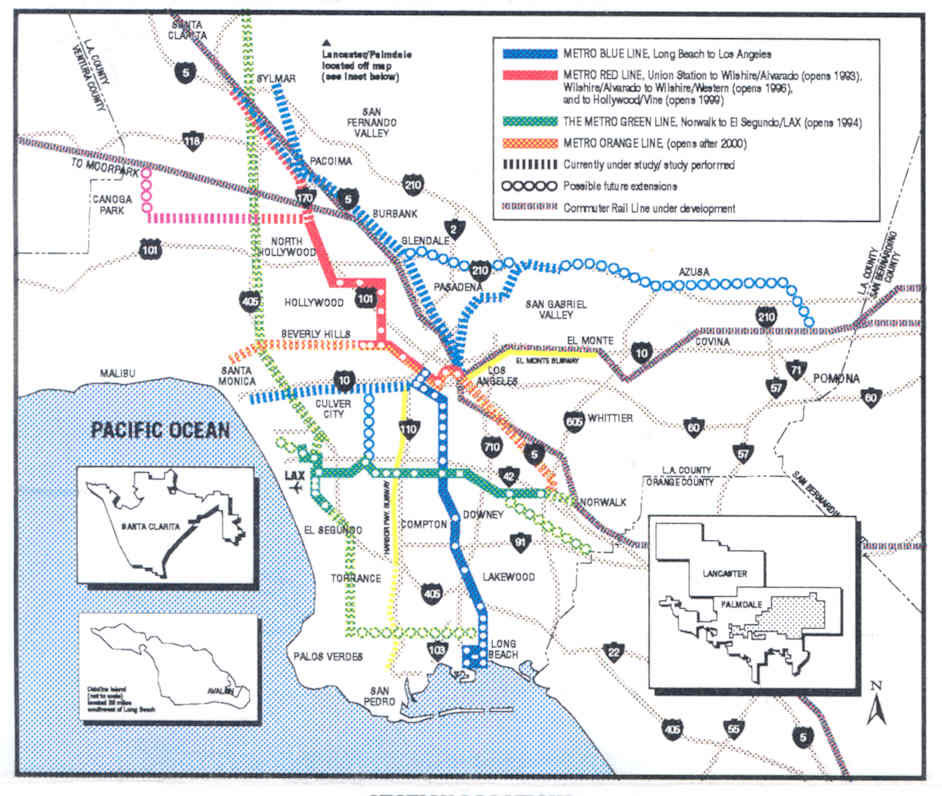
In 1993, the State implemented a merger of the SCRTD and LACTC, to form the current organization, LACMTA, Los Angeles County Metropolitan Transportation Authority. Bits and pieces of a regional transportation grid began to emerge, See map below. (It can be enlarged by opening the link.)

1990 - Long Beach - Los Angeles Metro Blue Line opened.
1993 - Metro Red Line, Segment 1 opened.
1995 - Metro Green Line opened.
1996 - Metro Red Line, Segment 2a opened.
1999 - Metro Red Line, Segment 2b- opened.
2000 - Metro Red Line, Segment 3 - opened
2003 - Metro Gold Line opened.
2005 - Metro Orange Line opened.
2008 - "Bring Back Broadway" initiative with its Streetcar project announced.
2009 - Metro Gold Line Eastside Extension opened.
2011 - Metro Exposition Line, Phase 1, scheduled completion.
2012 - Metro Exposition Line, service to Venice/Robertson station scheduled.
2018 - Metro Regional Connector, (See map below.) scheduled to be completed.
Located Downtown, it will connect the Blue and Expo Lines to the Gold Line and Union Station.
????? - "Subway to the Sea," conditions are not sufficiently clear to predict when trains will be operating to Santa Monica.


  Passengers boarding a Metro Red Line train at Seventh and Figueroa. 

                                                  The Regional Connector.

The Rebirth / Chapter Two

Ostensibly, transportation improvements might appear to be on autopilot; however, this is hardly the case. The economy, local, regional, state and national politics will all have their impact. In 2007, Move LA, an organization dedicated to supporting local transportation initiatives, built a coalition of business, labor and environmental organizations to identify and secure new funds for transportation investments in Los Angeles County. A January 2008, a Move LA conference served as the launching pad for Measure R, a one half cent sales tax that would provide $40 million for transportation projects in Los Angeles County over the next 30 years.  In November 2008, Los Angeles County voters approved Measure R with a 67.22% margin, a hair above the California State requirement of 2/3 support for new taxes. Mayor Antonio Villaraigosa championed this initiative and has emerged to play a leading role in national transportation policies. 

Move LA spearheaded the National Infrastructure Development Bank and its associated 30/10 Plan which could lead to the completion of all Los Angeles' 12 Measure R transit projects in 10 years rather than 30 years. Mayor Villaraigosa and his staff, working with Metro staff, refined the program into a legislative package known as Move LA's 30/10 Plan. Subsequently, this plan was endorsed by Senators Boxer and Feinstein, the LA Metro Board and Richard Trumka, President of AFL-CIO, among others. An innovative funding methodology emerged. Rather than wait for Federal grant monies which might or might not be delivered, Move LA conceived of a plan to obtain credit assistance and tax code incentives which reduced the cost of borrowing and accelerated the delivery of construction funds. 

On June 21, I attended Move LA's all-day conference, "A Bigger Vision: Moving LA Fast Forward." The breadth of participants was staggering: local, state and regional transportation, local, state and regional government, business, labor, environment, housing, bicyclists, and neighborhood leaders. It was clear that everyone shared the same objective: to accelerate the construction of LA's much needed transportation projects as rapidly as possible.

Implementing these mass transit objectives is critical to the future of Los Angeles. As the world continues to become increasingly urbanized, Los Angeles must be remain competitive.


The above diagram indicates world population growth between 1950 and 2005. During this period, the world's population tripled reaching 3.15 billion. Cities in the developing world are growing rapidly. By 2020, 77% of the world's population is expected to live in cities in developed countries. Individual mobility demands can be satisfied most efficiently in urban areas. The Los Angeles expanding transportation system is going to assist this region in coping with the demands of increasing new populations as they arrive.

Getting back to Move LA's all-day conference, LA Metro CEO, Art Leahy, said that the had taken the Gold Line from Pasadena to Union Station and walked up the Temple Street hill to Cathedral Plaza, the site of the conference. I, too, took the Gold Line to Union Station, transfered to the Blue Line and got off at City Hall. Then I walked up Tempe Street hill. As I walked, I did not find any compatriots. I saw a continuous line of cars entering the Cathedral parking garage. At the Move LA conference, I wanted to ask if anyone else had taken public transportation; however, I was afraid to raise the issue for fear of injecting a dissident note because it was apparent that few had.

Then, I saw Green T - Tamara Henry, with her large red STOP sign describing her 1hour and 35 minute bus ride from Venice to Downtown LA,  She made the point much more effectively than I could.

Follow this link to Tamar's detailed report on the June 21, event. Move LA - Moving LA Fast Forward

As the conference ended, I was walking down the stairs with LA Metro CEO, Art Leahy, and told him how much I liked the LA subways because they reminded me of New York. He said, "I hate New York!"